Introduction
If you have ever wondered why some websites consistently appear at the top of Google while others remain buried on page 10, the answer is almost always the same: SEO. But what is SEO, and how does it work—and is it something any website owner can actually do?
Search engine optimization is both a science and a strategy. Done correctly, it transforms your website from an invisible corner of the internet into a steady, reliable source of organic traffic, leads, and revenue. In this complete guide, we explain everything from the fundamentals to the advanced tactics that are working right now in 2026.
Read Also: How Does Google Rank Websites?
What Is SEO? A Simple Definition
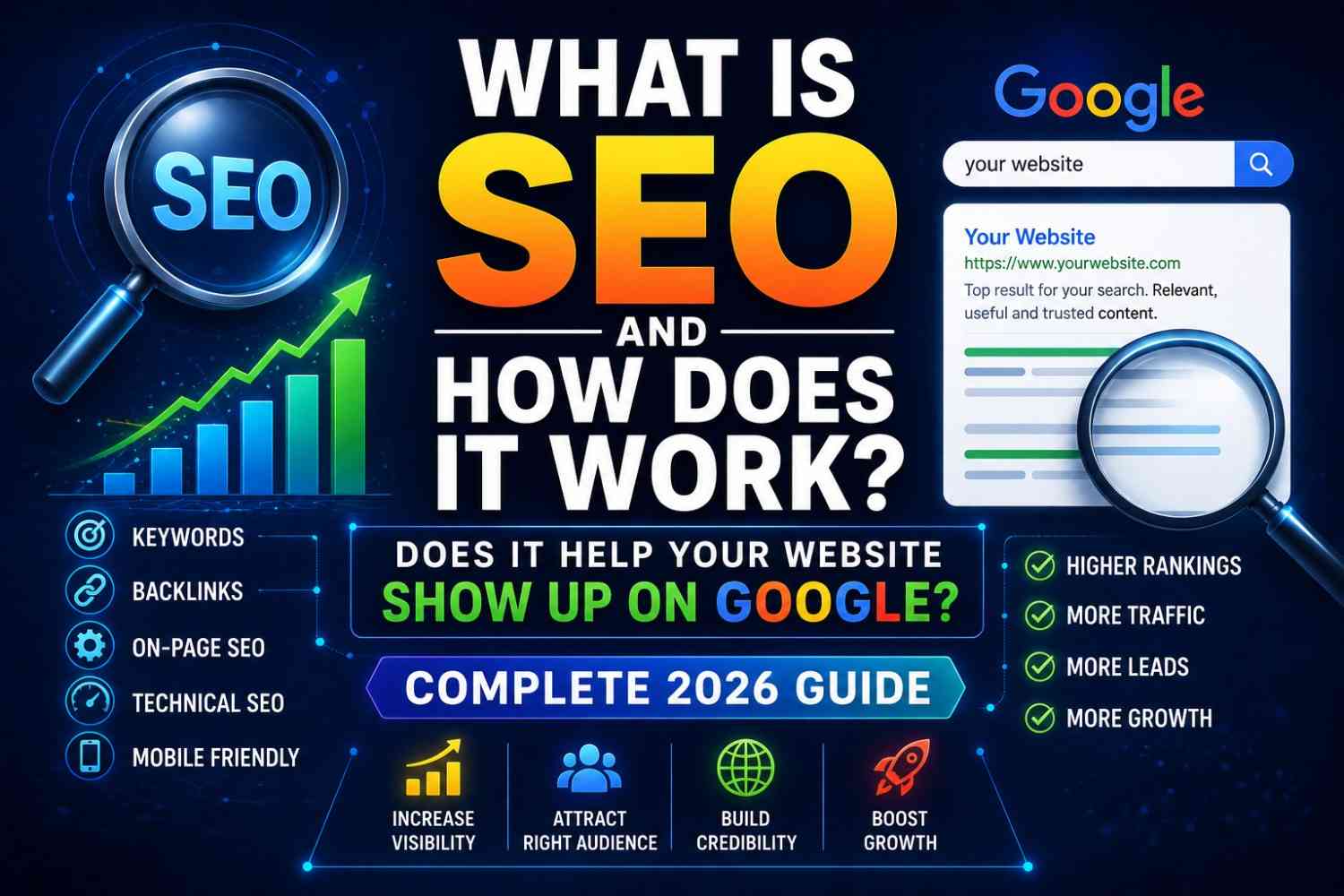
SEO (Search Engine Optimization) is the practice of optimizing your website and its content to rank higher in search engine results pages (SERPs) for relevant search queries—without paying for ads.
The goal of SEO is straightforward: help search engines understand your content so they can show it to the right people at the right time.
Unlike paid advertising, SEO builds long-term, sustainable visibility. A well-optimized page can drive traffic for years without any ongoing cost per click.
What Is SEO and How Does It Work? The Three Pillars
Every effective SEO strategy rests on three pillars:
Pillar 1: Technical SEO
Technical SEO ensures search engines can efficiently crawl, render, and index your website. It is the foundation everything else is built on.
Key technical SEO elements:
- Site speed—Fast-loading pages improve both crawling and user experience
- Mobile-friendliness—Google uses mobile-first indexing
- HTTPS—Secure connections are a confirmed ranking signal
- XML sitemaps—Help Google discover all your pages
- Robots.txt—Controls which pages crawlers can access
- Core Web Vitals—LCP, INP, CLS measurements
- Structured data (Schema)—Helps Google understand page content context
- Crawl error resolution—Fixing 404s, redirect chains, and server errors
Pillar 2: On-Page SEO
On-page SEO optimizes individual pages for specific target keywords and search intent.
Key on-page SEO elements:
- Title tag—The most important on-page ranking signal
- Meta description—Influences click-through rate from search results
- H1 and heading structure—Organizes content for readers and crawlers
- Keyword placement—Target keyword in the first 100 words, headings, and naturally throughout
- Content quality and depth—Comprehensive, accurate, original content
- Image optimization — ALT text, compression, descriptive file names
- Internal linking—Connects related pages and distributes page authority
- URL structure—Short, descriptive, keyword-containing URLs
Pillar 3: Off-Page SEO
Off-page SEO builds your website’s authority and reputation through signals from other websites and platforms.
Key off-page SEO elements:
- Backlink building—Earning links from authoritative, relevant websites
- Digital PR — Getting coverage and links from media outlets
- Brand mentions—Even unlinked mentions can signal authority
- Social signals—Indirect effects through brand awareness and traffic
- Guest posting — Publishing content on relevant external sites
Keyword Research: The Starting Point of Every SEO Strategy
Before optimizing anything, you need to know what your audience is searching for. Keyword research identifies:
- Search volume—How many people search this term monthly?
- Keyword difficulty—How competitive is this term?
- Search intent—What does the searcher actually want?
- Long-tail keywords—longer, more specific phrases with lower competition
For example, “shoes” is a head keyword with enormous competition. “Best waterproof hiking shoes for women under $100” is a long-tail keyword with specific intent and far less competition.
Targeting long-tail keywords is especially valuable for new or small websites that cannot yet compete with established authorities on broad terms.
Search Intent: The Most Important SEO Concept in 2026
Google’s core job is to satisfy search intent—the real reason behind a search query. The four types of search intent are:
| Intent Type | What the User Wants | Example Query |
|---|---|---|
| Informational | To learn something | “how does photosynthesis work?” |
| Navigational | To find a specific site | “Facebook login” |
| Commercial | To research before buying | “best laptops 2026” |
| Transactional | To buy or act now | “buy iPhone 16 Pro.” |
Matching your content format and depth to search intent is as important as including the right keywords.
Content Strategy: How SEO and Content Marketing Work Together
In 2026, SEO and content marketing are inseparable. The most effective content strategy for SEO involves
- Topical authority—building comprehensive coverage of your subject area, not just individual pages
- Content clusters—a pillar page covering a broad topic supported by multiple in-depth cluster articles
- Regular updates—refreshing older content to maintain rankings and freshness signals
- Original research—data and studies attract natural backlinks
- E-E-A-T signals—author bios, credentials, citations, and references
Local SEO: Showing Up for Nearby Searches
For businesses serving a local market, local SEO is a critical subset of the overall strategy:
- Google Business Profile — fully completed and regularly updated
- Consistent NAP data—name, address, and phone—must match across all directories
- Customer reviews—Quantity and quality of reviews influence local rankings
- Local content — Pages targeting city and region-specific keywords
- Local backlinks—Links from local chambers of commerce, news sites, and business directories
How Long Does SEO Take to Work?
One of the most common questions about what SEO is and how it works is the timeline. Realistic expectations:
- Technical fixes—Impact can be seen within days to weeks
- New content—Initial rankings typically appear within 3–6 months
- Competitive keywords—May take 12–24 months for top positions
- Link building—New backlinks may take 2–3 months to fully influence rankings
SEO is a long-term investment, not a quick fix. The results, however, compound over time—unlike paid advertising that stops the moment you stop paying.
FAQs: What Is SEO and How Does It Work
Q1: What is SEO in simple terms? SEO is the process of optimizing your website so it appears higher in Google and other search engine results when people search for topics related to your business.
Q2: Is SEO free? The organic traffic SEO generates is free. However, investing in tools, content creation, and expertise typically requires budget.
Q3: What is the difference between SEO and paid ads? SEO generates organic (free per click) traffic through rankings. Paid ads (PPC) generate traffic through paid placements that appear above organic results.
Q4: How do I start SEO for my website? Begin with a technical audit (fix crawl errors, improve speed), conduct keyword research, optimize your key pages, and start building quality content and backlinks.
Q5: Does SEO still work in 2026 with AI overviews? Yes. While AI overviews have changed the SERP landscape, organic results still drive significant traffic. SEO also helps your content appear within AI Overviews.
Q6: What is the most important SEO factor? There is no single most important factor. Relevance (content quality and intent match), authority (backlinks), and technical accessibility all work together.
Conclusion
Now you have a thorough answer to what SEO is and how it works—from technical foundations to content strategy to link building. SEO is not a trick or a shortcut. It is the disciplined practice of making your website genuinely better for both users and search engines. The websites that win in 2026 are those that commit to quality, consistency, and user-first thinking. Start your SEO journey today with a free account at Google Search Console and explore deeper strategies with Moz’s Beginner’s Guide to SEO.