Introduction
Have you ever Googled a question and immediately found the answer displayed in a box at the very top of the page—before any regular results? That box is a featured snippet, and it represents one of the most valuable pieces of real estate in all of digital marketing. But what are featured snippets, and how do they work? And how does Google decide which content to show?
Featured snippets are often called “Position Zero” because they appear above the traditional number one organic result. Winning one can dramatically increase your visibility, authority, and click-through rate. In this complete guide, we break down everything you need to know about featured snippets, the types that exist, how Google selects them, and exactly how to optimize your content to earn them.
Also Read: How Does Google’s Algorithm Work? 7 Core Updates
What Are Featured Snippets?
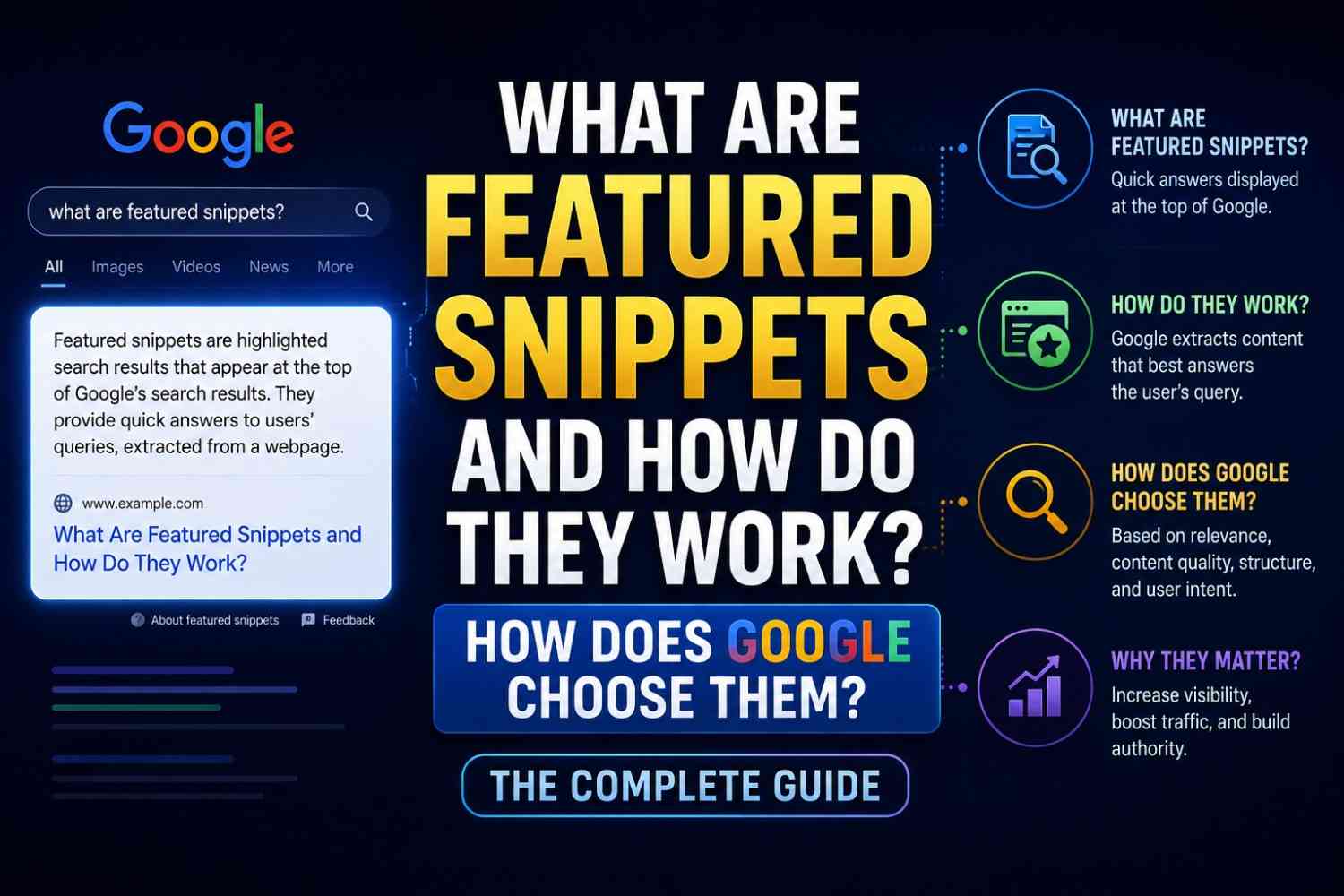
Featured snippets are automatically selected excerpts that Google displays at the top of its search results in response to questions and informational queries. They are pulled from an indexed web page and displayed in a distinct box that includes:
- The answer or content excerpt
- The page title
- The URL
- Sometimes an accompanying image
Featured snippets are Google’s attempt to answer the user’s query directly on the SERP—without requiring a click. They are generated algorithmically, without payment, and can be claimed by any website whose content best answers the query.
What Are Featured Snippets and How Do They Work? The Types
Type 1: Paragraph Snippets
The most common type. Google displays a short paragraph of text (typically 40–60 words) that directly answers a question.
Best triggered by: “What is…” “Why does…” “How does…” questions Example query: “What is photosynthesis?”
Type 2: List Snippets (Ordered and Unordered)
Google displays a numbered or bulleted list. Ordered lists are used for step-by-step processes; unordered lists for collections or comparisons.
Best triggered by: “How to…” “Steps to…” “Best ways to…” “Types of…” Example query: “How to set up two-factor authentication”
Type 3: Table Snippets
Google extracts a table from a page to display data comparisons, pricing, schedules, or specifications.
Best triggered by: Comparison queries, pricing questions, scheduling questions Example query: “Protein content in common foods”
Type 4: Video Snippets
Google displays a YouTube video (occasionally a web video) as the featured snippet, sometimes with a specific timestamp highlighted as the answer.
Best triggered by: “How to…” visual tutorial queries Example query: “How to tie a Windsor knot”
Type 5: Accordion / “People Also Ask” Adjacent Snippets
These are expanded featured snippets related to the People Also Ask section, offering layered answers to follow-up questions.
How Does Google Choose Featured Snippets?
Understanding the selection mechanism is the key to optimizing for featured snippets. Google’s selection process considers:
Factor 1: Already Ranking on Page One
The overwhelming majority of featured snippets are pulled from pages already ranking in the top 10 organic results—typically positions 1–5. If you are not on page one, winning a featured snippet is highly unlikely.
Factor 2: Content Directly and Concisely Answers the Query
Google selects snippets from content that:
- Directly addresses the search query (often matching the exact question)
- Provides a complete, concise answer
- Uses clear, simple language
- Does not require additional context to understand the answer
Factor 3: Proper Formatting
Content structured to match the expected snippet type has a much higher chance of being selected:
- Paragraphs for definition/explanation queries
- Numbered lists for process/step queries
- Tables for comparison/data queries
Factor 4: Schema Markup
While not required, properly implemented structured data (Schema.org) helps Google understand your content’s purpose and can increase featured snippet eligibility.
Factor 5: Page Authority and Trustworthiness
Google is more likely to select snippets from authoritative, trusted sources—particularly for YMYL (health, finance, and legal) topics where accuracy is critical.
The Featured Snippet SEO Opportunity
Winning a featured snippet delivers significant benefits:
- Increased visibility—Position Zero stands out visually above all organic results
- Authority signaling—Being selected by Google as the best answer builds brand trust
- Voice search integration—Featured snippets are the primary source for voice assistant answers
- Traffic uplift—Higher CTR for informational queries that display snippets
- Competitive displacement—You can “outrank” the page ranking above you in organic results
How to Optimize Your Content for Featured Snippets
Now that you understand what are featured snippets and how do they work, here is your actionable optimization strategy:
Step 1: Identify Snippet Opportunities
Use SEO tools (Semrush, Ahrefs, Moz) to find:
- Queries where you rank in positions 1–10 but no snippet exists
- Queries where a competitor holds the snippet
- Question-format queries relevant to your content
Step 2: Structure Your Content to Answer Directly
For every target query, include a direct answer within the first 2–3 sentences of your response. Format it to match the expected snippet type.
For a paragraph snippet:
- State the direct answer in 40–60 words
- Follow with supporting detail
For a list snippet:
- Use proper HTML
<ol>or<ul>tags - Keep list items concise and action-oriented
- Aim for 4–8 items (Google typically shows 4–8 in snippets)
For a table snippet:
- Use proper HTML
<table>tags - Include clear headers in the first row
- Keep data clean and scannable
Step 3: Use Question-Formatted Headings
Include the target question verbatim as an H2 or H3 heading—exactly as users search it. Follow the heading immediately with a direct answer.
Step 4: Add FAQ Sections
FAQ sections with question headings followed by concise answers are a powerful way to capture multiple featured snippets from a single page.
Step 5: Implement FAQ Schema
Add FAQ Schema markup to question-and-answer sections. This can help Google identify and surface your content as a snippet source.
Can You Opt Out of Featured Snippets?
Yes. If you prefer not to have your content appear as a featured snippet (perhaps because your business model relies on users clicking through to your site), you can add the data-nosnippet HTML attribute to specific sections or use the max-snippet robots meta tag to limit snippet length.
Featured Snippets vs. AI Overviews: What Is the Difference?
In 2026, Google’s AI Overviews (powered by Gemini) have partially overlapped with traditional featured snippets. Key differences:
| Feature | Featured Snippets | AI Overviews |
|---|---|---|
| Source | Single web page | Multiple sources synthesized |
| Attribution | Clear link to source page | Links to multiple sources |
| Format | Exact excerpt | AI-synthesized summary |
| Optimization | Directly optimizable | Less directly controllable |
| Availability | Most searches | Complex and informational queries |
Both are important to target. Featured snippet optimization helps your content appear as a cited source in AI Overviews as well.
FAQs: What Are Featured Snippets and How Do They Work
Q1: What are featured snippets in Google search? Featured snippets are text boxes displayed at the top of Google results that directly answer a query, pulled from an indexed web page.
Q2: Does having a featured snippet guarantee more clicks? Not always. For simple factual queries, users may get their answer from the snippet without clicking. For complex topics, snippets typically increase clicks by establishing authority.
Q3: How do I know if my content has a featured snippet? Search the target query in Google. Also check your Google Search Console for queries with high impressions but zero clicks—these may have snippets answering the question directly.
Q4: Can any website win a featured snippet? Any website ranking on page one can potentially win a featured snippet—regardless of domain authority—if the content directly and clearly answers the query.
Q5: How many words should a featured snippet answer be? For paragraph snippets, 40–60 words is the sweet spot. Google typically truncates longer answers.
Q6: Do featured snippets help with voice search? Yes, significantly. Voice assistants like Google Assistant primarily read featured snippet content as their spoken answer.
Conclusion
You now know exactly what featured snippets are and how they work—from the types of snippets to the selection signals to the optimization strategies that win them. Featured snippets are one of the most accessible and impactful SEO opportunities available in 2026. Any website already ranking on page one can compete for Position Zero with the right content structure. Start by auditing your existing page-one rankings for snippet opportunities using Semrush or Ahrefs and restructure your top-performing pages to answer questions directly and concisely.