Introduction
Every single day, over 8.5 billion searches are made on Google alone. But have you ever stopped to wonder—how do search engines work? How does typing a few words into a box return exactly the right answer in under a second from a database of over a trillion web pages?
The process behind every search result is a sophisticated, multi-layered system involving automated bots, massive data centers, and advanced AI algorithms. Understanding how search engines work is no longer just for tech professionals. In 2026, this knowledge is essential for business owners, content creators, marketers, and anyone who wants their content to be found online.
This guide walks you through the complete, step-by-step process—from the moment a new webpage is published to the moment it appears in your search results.
Read Also: How Does Android Navigation Work? Google Maps Route Technology Explained (2026)
What Is a Search Engine?
A search engine is a software system designed to carry out web searches—searching the World Wide Web systematically for particular information specified in a text-based query.
The most widely used search engines in 2026 include:
- Google—~92% global market share
- Bing—~3–4% global market share
- Yahoo—powered by Bing
- Baidu—dominant in China
- DuckDuckGo—privacy-focused alternative
- Yandex—dominant in Russia
Despite their differences, all search engines follow the same fundamental process to deliver results.
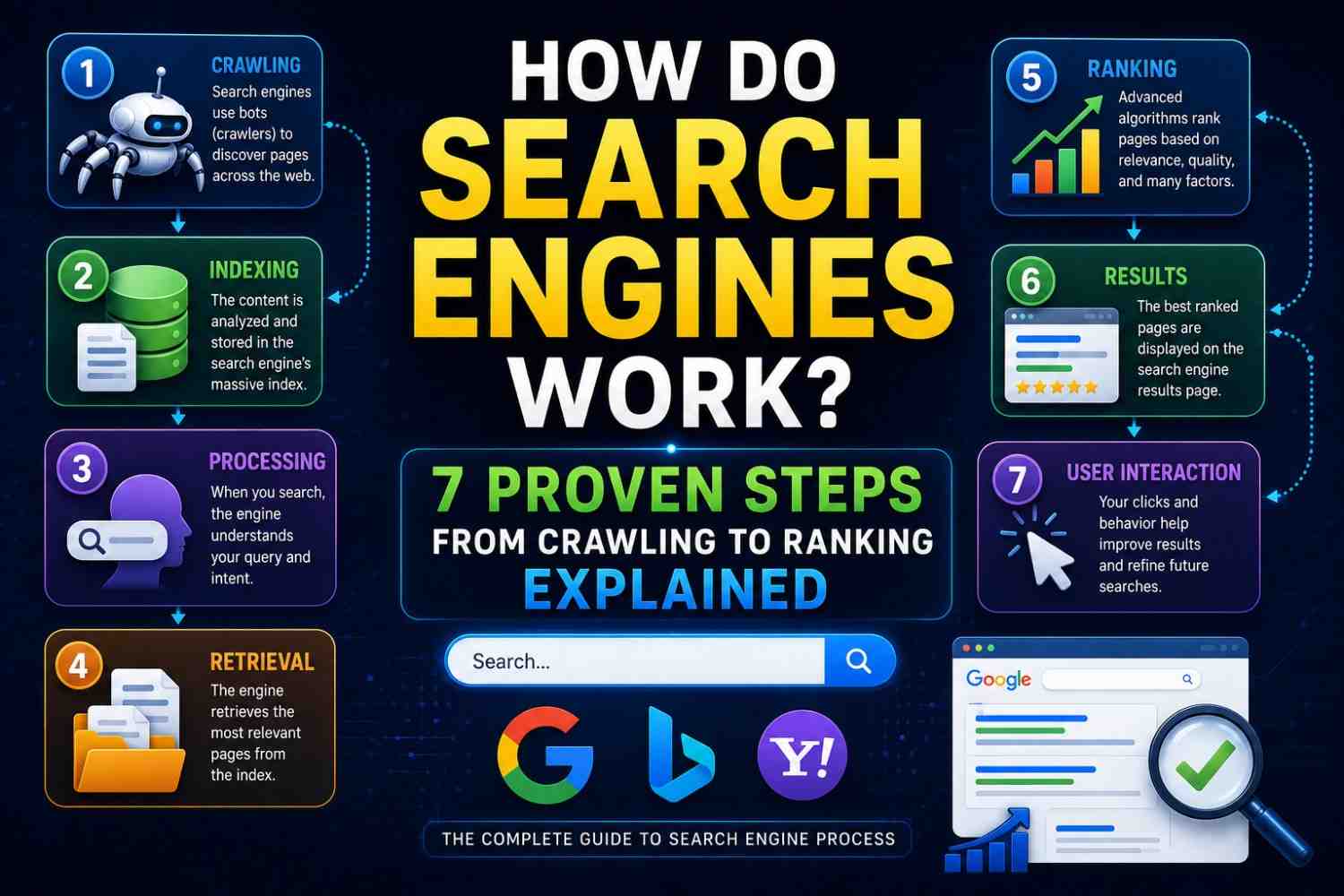
The 7 Steps: How Do Search Engines Work?
Step 1: Crawling
The first stage of understanding how search engines work is crawling. Search engines use automated bots called web crawlers (also called spiders or Googlebots) to continuously browse the internet.
These bots follow links from page to page, discovering new content and revisiting known pages. When a crawler visits your webpage, it reads the page’s content, HTML code, links, and metadata.
Googlebot crawls billions of URLs every day. It prioritizes pages based on:
- How often the page changes
- How many other sites link to it
- The page’s overall authority and quality
Step 2: Rendering
After crawling, search engines must render the page—essentially loading it as a browser would, executing JavaScript, and understanding what the page actually looks like to a user.
This step is critical because modern websites heavily rely on JavaScript frameworks (React, Vue, Angular). If a search engine cannot render your page, it may miss important content.
Step 3: Indexing
Once a page is crawled and rendered, the search engine processes its content and stores relevant information in its index—an enormous database containing information about trillions of web pages.
Think of the index as the world’s largest library catalog. When you search, Google does not search the entire internet in real time. It searches its pre-built index, which is why results are delivered in milliseconds.
Not every page makes it into the index. Pages blocked by robots.txt, those marked with noindex tags, duplicate content, or low-quality pages may be excluded.
Step 4: Processing the Query
When you type a search query, the search engine begins processing it immediately. This involves:
- Query parsing—breaking down your query into meaningful components
- Spell checking—correcting typos and suggesting alternatives
- Intent classification—determining whether you want information, a product, a local business, or a specific website
- Keyword expansion—understanding synonyms and related terms
Modern AI systems like BERT and MUM enable search engines to understand the true meaning behind your query, not just the literal words.
Step 5: Matching and Retrieval
The search engine retrieves all pages from its index that are relevant to your query. This initial matching considers:
- Does the page contain the query terms?
- In what context are the terms used?
- What is the topic and intent of the page?
Hundreds of millions of candidate pages may match a broad query. The retrieval phase narrows these down to the most promising candidates for ranking.
Step 6: Ranking
Ranking is the most complex step and the one that determines what you actually see. Search engines apply hundreds of ranking signals to sort retrieved pages from most to least relevant.
Key ranking factors include:
- Relevance — How well does the content match the query’s intent?
- Authority—How many quality websites link to this page?
- Quality—Is the content accurate, well-written, and trustworthy?
- User experience—Is the page fast, mobile-friendly, and easy to navigate?
- Freshness—Is the content recent and up-to-date?
- Personalization—What are the user’s location, history, and device?
Google uses AI systems like RankBrain, BERT, and its Helpful Content system to evaluate these signals simultaneously.
Step 7: Displaying Results
Finally, the ranked results are presented to the user in the Search Engine Results Page (SERP). In 2026, a typical Google SERP may include:
- Organic blue link results
- AI Overviews (Gemini-generated summaries)
- Featured snippets
- People Also Ask boxes
- Local pack (Maps results)
- Image and video carousels
- Shopping results
- News boxes
The entire process—from your keypress to displayed results—takes less than 500 milliseconds.
How Search Engines Handle Different Types of Content
Search engines treat different content types differently:
| Content Type | Crawlability | Special Treatment |
|---|---|---|
| HTML text | Excellent | Standard indexing |
| JavaScript content | Moderate | Requires rendering |
| PDF documents | Good | Text extracted |
| Images | Limited | ALT text analyzed |
| Video | Limited | Transcripts help |
| Audio | Poor | Needs transcription |
Why Understanding Search Engines Matters for SEO
Knowing how search engines work is the foundation of effective SEO. Every SEO best practice maps directly to one of these seven steps:
- Technical SEO — Optimizes crawling and rendering
- On-page SEO—Improves indexing and relevance
- Link building—Builds authority for better ranking
- Content strategy—Satisfies user intent to win rankings
- Core Web Vitals—Improves page experience signals
The Evolution of Search: From Keywords to Intent
Early search engines matched exact keywords. Modern search engines understand meaning, context, and intent. This evolution means:
- You no longer need to keyword stuff to rank
- Content that naturally answers user questions performs better
- Topical authority—covering a subject comprehensively—outperforms single-page tactics
FAQs: How Do Search Engines Work
Q1: How do search engines find new websites? They discover new websites through links from already-indexed pages, XML sitemaps submitted by webmasters, and direct URL submissions via tools like Google Search Console.
Q2: How long does it take Google to index a new page? Typically a few days to a few weeks for new pages. High-authority websites can get indexed within hours.
Q3: How do search engines decide which page to rank first? They evaluate hundreds of signals, including content relevance, page authority (backlinks), user experience, and content quality.
Q4: Can a website block search engine crawlers? Yes. Using a robots.txt file or noindex meta tags, website owners can prevent specific pages or the entire site from being crawled and indexed.
Q5: Do all search engines use the same index? No. Each search engine maintains its own independent index. Google, Bing, and Baidu each build and maintain separate indexes.
Q6: How do search engines handle duplicate content? They attempt to identify the original version using canonical tags or internal signals and typically only index one version, which can affect rankings.
Conclusion
Now you understand exactly how search engines work—from the crawling bots that discover your content to the AI algorithms that decide where it ranks. This knowledge is the bedrock of every successful digital marketing strategy. Whether you are a beginner or a seasoned professional, aligning your website with these seven steps will dramatically improve your visibility in 2026. Start by submitting your sitemap at Google Search Console and check how Googlebot sees your site today.