Introduction
Google processes over 99,000 searches every single second. Each one delivers a unique, personalized set of results — in under half a second. But how does Google search work at this scale, with this speed, and with this level of accuracy?
Behind the simple white homepage lies one of the most complex technological systems ever built. It combines the world’s largest index of web content, cutting-edge artificial intelligence, and hundreds of ranking signals — all operating in perfect synchrony. In this guide, we break down the complete picture of how Google search works, from the moment a page is published to the moment it lands in front of the right searcher.
Read Also: How Do Search Engines Work? 7 Proven Steps
Google’s Three Core Systems
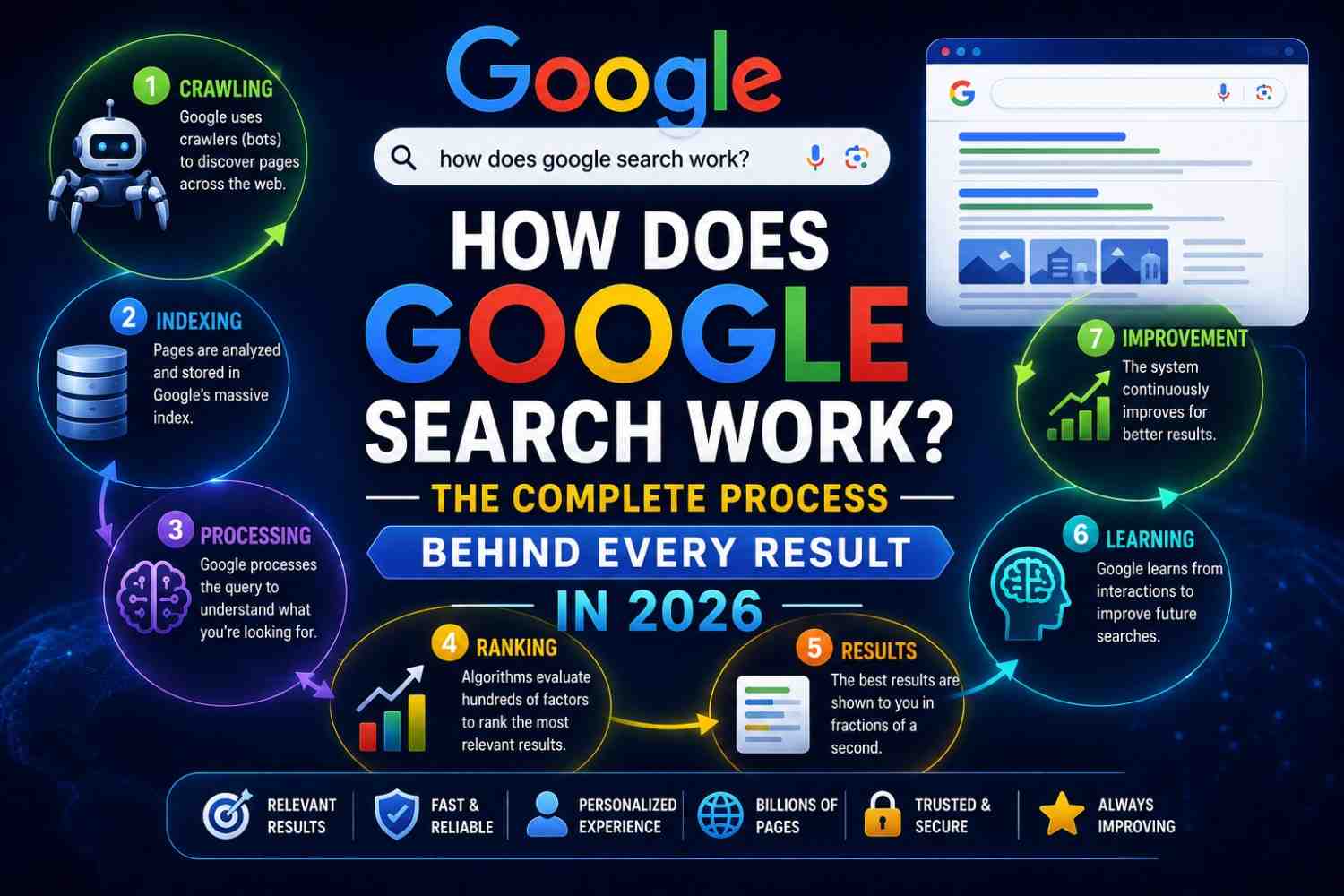
To understand how does Google Search works, you first need to know that Google search is not one system—it is three:
- Crawling — Discovering web content using automated bots
- Indexing — Storing and organizing discovered content in a massive database
- Serving results — Matching user queries to indexed pages using ranking algorithms
Each system is enormous in scale and complexity. Let’s explore each in detail.
System 1: Google’s Crawling Process
What Is Googlebot?
Googlebot is Google’s web crawling program. There are multiple versions:
- Googlebot Desktop — simulates a desktop browser
- Googlebot Smartphone — simulates a mobile device
- Googlebot Image, Video, News — specialized crawlers for different content types
Google primarily crawls and indexes using the mobile-first approach. This means the mobile version of your website determines your search ranking.
How Googlebot Discovers Pages
Googlebot discovers new pages through:
- Links from already-indexed pages — the primary discovery method
- XML sitemaps — files that list all pages on your site
- Direct URL submissions — via Google Search Console
- Redirects — following 301 redirects to new URLs
Google controls crawl frequency using a crawl budget — the number of pages it will crawl on your site within a given time frame. Larger, higher-authority sites get more crawl budget.
System 2: Google’s Indexing Process
From Raw HTML to Structured Data
After crawling, Google’s indexing system processes each page:
- HTML parsing — extracting text, links, and metadata
- JavaScript rendering — executing JavaScript to reveal dynamically loaded content
- Language detection — identifying the page’s language
- Canonicalization — selecting the preferred URL when duplicate content exists
- Quality assessment — evaluating whether the page is worth indexing
Google’s Index: The Scale of It
Google’s search index contains hundreds of billions of web pages and takes up over 100 petabytes of storage. It is updated continuously, with some pages recrawled and reindexed within hours.
When you search, Google is not scouring the live web. It is searching this prebuilt, constantly updated index — which is why results appear in milliseconds.
System 3: How Google Ranks and Serves Results
The Query Understanding Phase
When you type a search query, Google’s systems immediately begin analyzing it:
- Spelling correction — Did you mean “weather” not “weathr”?
- Synonym handling — “automobile” and “car” are treated as equivalent
- Intent classification — Is this query informational, navigational, or transactional?
- Freshness requirement — Does this query need recent results (news) or are evergreen results fine?
Google’s Core Ranking Systems
Google uses multiple ranking systems working in layers. Key systems include:
RankBrain — A machine learning system that interprets ambiguous queries and maps them to the most likely intended meaning.
BERT — A natural language understanding model that reads queries and pages bidirectionally to understand full context.
MUM (Multitask Unified Model) — Handles complex, multi-part queries across languages and content formats simultaneously.
Helpful Content System — Rewards content written for humans, not just search engines. Introduced in 2022 and strengthened through multiple updates since.
SpamBrain — Google’s AI-powered anti-spam system that detects and demotes manipulative content and unnatural link schemes.
The Hundreds of Ranking Factors
While Google never publishes a complete list of ranking factors, confirmed and widely accepted signals include:
- Relevance of content to the query
- Quality and depth of content (E-E-A-T)
- Number and quality of inbound links (PageRank)
- Page experience (Core Web Vitals: LCP, INP, CLS)
- Mobile-friendliness
- HTTPS security
- Content freshness
- User location and personalization
- Search history and behavioral signals
How Google Personalizes Your Search Results
A frequently overlooked aspect of how does Google search work is personalization. Two people searching the same query in different locations, devices, or with different Google histories may see completely different results.
Personalization factors include:
- Location — Local businesses and regional news are prioritized
- Language and country settings — Results filtered by region
- Search history — Previous clicks influence future results
- Device type — Mobile results may differ from desktop
- Signed-in account — Connected Google services influence results
You can see a more neutral view by searching in Incognito mode, which disables personalization.
Google’s SERP Features in 2026
The traditional “10 blue links” result page has evolved dramatically. A modern Google SERP may contain:
| Feature | Description |
|---|---|
| AI Overviews | Gemini-powered answer summaries at the top |
| Featured Snippets | Direct answer boxes from a single source |
| People Also Ask | Expandable related questions |
| Local Pack | Map and 3 local business listings |
| Knowledge Panel | Entity information sidebar |
| Shopping Results | Product listings with prices |
| Image Pack | Row of relevant images |
| Video Results | YouTube or web videos |
| News Box | Recent news articles |
| Sitelinks | Sub-pages for branded searches |
Understanding these features is essential for modern SEO because they often appear above traditional organic results.
Google E-E-A-T: The Quality Framework
Since 2022, Google has formally emphasized E-E-A-T as its content quality framework:
- Experience — Has the author personally experienced the topic?
- Expertise — Does the author have relevant knowledge and credentials?
- Authoritativeness — Is the author or site recognized as an authority in the field?
- Trustworthiness — Is the content accurate, honest, and transparent?
E-E-A-T is not a direct ranking factor — it is the evaluative framework used by Google’s human quality raters and reflected in its ranking systems.
How Google’s Core Updates Affect Rankings
Several times a year, Google releases Core Algorithm Updates that recalibrate how its systems weigh various ranking signals. These updates can cause significant ranking changes for millions of websites.
Best practices for surviving core updates:
- Create genuinely helpful content for real users
- Maintain accurate, fact-checked information
- Build authentic authority through quality backlinks
- Deliver excellent page experience
- Avoid manipulative tactics — they eventually get penalized
FAQs: How Does Google Search Work
Q1: How does Google search work to find relevant results? Google matches your query against its index of hundreds of billions of pages using AI-powered relevance signals, ranking the most useful and authoritative results first.
Q2: How quickly does Google index new content? For established websites, new pages can be indexed within hours. Brand new websites may take days to weeks to see their first page indexed.
Q3: Does Google favor longer content? Not inherently. Google favors content that most completely and helpfully answers the user’s query. Sometimes that requires length; sometimes brevity is better.
Q4: Why do my rankings change without me doing anything? Google constantly refines its algorithms, recrawls pages, discovers new competition, and updates its index — all of which can shift rankings without any action on your part.
Q5: Does Google track my search history? Yes, when you are signed into a Google account. This data influences personalized results and ad targeting. You can review and delete it via myactivity.google.com.
Q6: What is Google’s most important ranking factor? There is no single most important factor. Relevance, authority (quality backlinks), content quality, and page experience all work together.
Conclusion
Understanding how does Google search work transforms the way you approach content creation, website optimization, and digital marketing. Google’s system — despite its incredible complexity — rewards the same fundamentals it always has: genuinely helpful content, technical accessibility, and real-world authority. In 2026, the best SEO strategy is still to be the best answer to your audience’s questions. Explore your site’s current performance today at Google Search Console and start optimizing with confidence.