Introduction
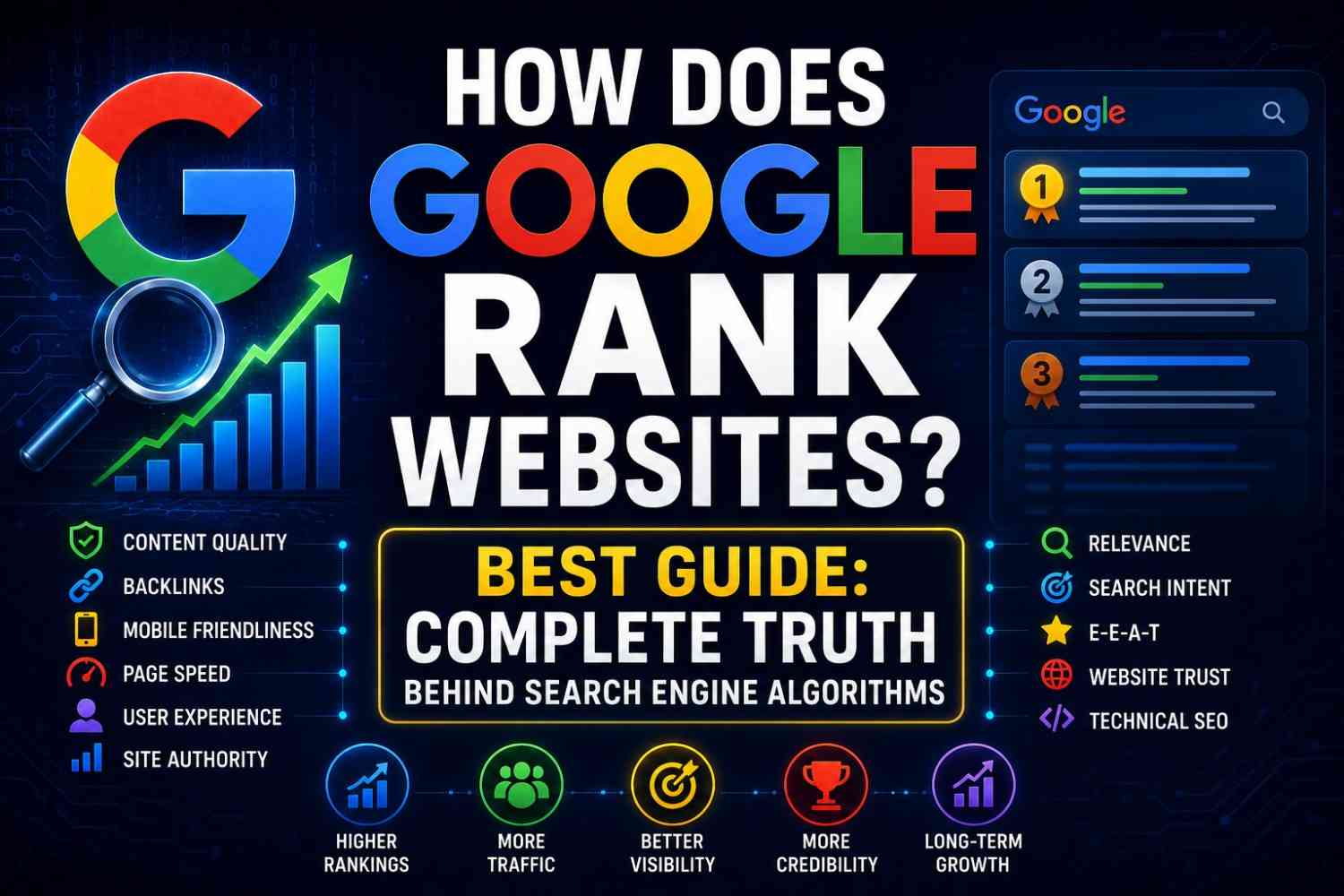
Millions of web pages compete for the same search terms. Yet Google always seems to know which one to put first. Have you ever wondered How Does Google Rank Websites—what separates the number one result from the page in position 47?
The answer involves a sophisticated combination of over 200 ranking signals, multiple artificial intelligence systems, and a constant evaluation process that runs billions of times per day. In this guide, we pull back the curtain on Google’s ranking systems—what they look for, what they reward, and what you can do to rise to the top in 2026.
Also Read: What Is Search Engine Indexing and Why Does It Matter for Your Website?
The Foundation: What Google Is Trying to Do
Before diving into specific ranking factors, it helps to understand Google’s fundamental goal: to provide the most useful, relevant, and trustworthy answer to every search query.
Every ranking decision Google makes is in service of this goal. Pages that genuinely help users climb. Pages that manipulate or deceive fall. This framing guides everything that follows.
A Brief History of Google’s Ranking Algorithm
- 1998 — PageRank launched: ranks pages by the number and quality of links pointing to them
- 2003 — Florida Update: penalizes keyword stuffing and manipulative tactics
- 2011 — Panda Update: demotes thin, low-quality content
- 2012 — Penguin Update: penalizes unnatural, purchased backlinks
- 2013 — Hummingbird: focuses on query meaning, not just keywords
- 2015 — RankBrain: AI enters Google’s ranking system
- 2018 — BERT: transformer-based language understanding
- 2021 — MUM: multimodal, multilingual AI model
- 2022 — Helpful Content System: rewards human-first content
- 2024–2026 — Gemini integration: AI Overviews, deeper semantic understanding
How Does Google Rank Websites? The Key Ranking Factors
1. Relevance: Does Your Content Match the Query?
The most basic requirement for ranking is relevance. Google assesses whether your page answers the user’s specific query by analyzing:
- Keywords and semantic terms — not just exact matches but related concepts
- Content depth — does the page comprehensively cover the topic?
- Search intent alignment — does the page format match what the user expects? (article, product page, tool, etc.)
- Topical authority — does your site cover this subject area broadly and authoritatively?
2. PageRank and Link Authority
PageRank — Google’s original ranking algorithm — is still a fundamental signal. Links from other websites act as “votes of confidence” for your content.
Key nuances:
- Quality beats quantity — one link from a highly authoritative site is worth more than 100 from low-quality sites
- Relevance matters — links from topically related sites carry more weight
- Anchor text — the clickable link text signals what the linked page is about
- Follow vs. nofollow — followed links pass authority; nofollow links technically do not (though Google may consider them as hints)
3. Content Quality and E-E-A-T
Google evaluates content quality through its E-E-A-T framework:
- Experience — First-hand experience with the topic
- Expertise — Knowledge and credentials in the subject area
- Authoritativeness — Recognition as a trusted source by others
- Trustworthiness — Accuracy, transparency, and honesty
Content written by identifiable authors with demonstrated expertise in their field ranks better for competitive and YMYL (Your Money, Your Life) topics.
4. Page Experience and Core Web Vitals
Since 2021, Google has used Core Web Vitals as ranking signals — measurements of real-world user experience:
| Metric | What It Measures | Good Threshold |
|---|---|---|
| LCP (Largest Contentful Paint) | Loading performance | Under 2.5 seconds |
| INP (Interaction to Next Paint) | Interactivity | Under 200 milliseconds |
| CLS (Cumulative Layout Shift) | Visual stability | Under 0.1 |
Beyond Core Web Vitals, Google also considers mobile-friendliness, HTTPS security, and intrusive interstitials (pop-ups that block content).
5. User Behavior Signals
While Google officially downplays direct behavioral signals, it uses aggregated user data to evaluate whether search results are satisfying users:
- Click-through rate (CTR) — Are users clicking your result?
- Dwell time — How long do users stay on your page?
- Bounce rate — Do users immediately return to search results?
- Pogo-sticking — Do users click your result, leave quickly, and click another result?
A page that consistently fails to satisfy users will drop in rankings over time.
6. Freshness
For certain query types, recency is a significant ranking factor:
- News and current events — Very high freshness requirement
- Product reviews — Moderate freshness requirement
- How-to guides — Low freshness requirement (unless topic changes frequently)
- Historical information — No freshness requirement
Google uses its Query Deserves Freshness (QDF) model to determine how much to weight freshness for a given query.
7. Local Signals (For Local SEO)
For searches with local intent — “coffee shop near me” or “plumber in Chicago” — Google applies additional ranking factors:
- Google Business Profile completeness and reviews
- Local citations (consistent NAP: Name, Address, Phone)
- Proximity to the searcher’s location
- Local backlinks from local organizations and directories
Google’s AI Ranking Systems
Modern Google ranking is heavily AI-driven. The key systems:
RankBrain — Handles ambiguous queries by mapping them to the most likely intent, drawing on machine-learned patterns from billions of past searches.
BERT — Reads the full context of a query bidirectionally, understanding nuanced meaning rather than isolated keywords.
Helpful Content System — A site-wide signal that rewards content demonstrably written for humans rather than primarily for search engine rankings.
SpamBrain — AI-powered system that identifies and demotes content that violates Google’s spam policies, including unnatural link patterns and AI-generated content produced purely for ranking.
What Does NOT Help You Rank (Despite Common Myths)
- Social media shares — Not a direct Google ranking factor
- Domain age — Age alone does not improve rankings
- Publishing frequency — Quality matters more than quantity
- Meta keywords tag — Google has ignored this for over a decade
- Exact match domains — No longer carry the significant advantage they once did
FAQs: How Does Google Rank Websites
Q1: How many ranking factors does Google use? Google uses over 200 confirmed and estimated ranking signals, processed through multiple AI systems simultaneously.
Q2: How long does it take to rank on Google? For new websites, typically 3–6 months for initial rankings. Competitive keywords may take 1–2 years of consistent effort.
Q3: Does Google penalize AI-generated content? Google penalizes low-quality content regardless of how it was produced. High-quality, helpful AI-assisted content can rank well.
Q4: Is link building still important for ranking in 2026? Yes. High-quality backlinks remain one of the most powerful ranking signals, though quality matters far more than quantity.
Q5: How important are Core Web Vitals for ranking? They are a confirmed ranking signal, but content relevance and quality typically have a larger impact. Strong Core Web Vitals help break ties between similar-quality pages.
Q6: Does Google rank based on social media presence? Not directly. Social media does not pass link authority to Google. However, social visibility can indirectly help by driving links and brand awareness.
Conclusion
Now you understand how does Google rank websites — not through guesswork or magic, but through a transparent (if complex) system that consistently rewards relevance, authority, quality, and user satisfaction. The best SEO strategy in 2026 is simple in principle: create genuinely helpful content, earn real authority, and deliver a great user experience. For detailed analysis of your site’s current ranking factors, explore tools like Ahrefs or Semrush to identify exactly where to focus your optimization efforts.