Introduction
A technology capable of writing novels, composing music, generating photorealistic images, coding software, and holding human-like conversations has arrived — and it is called generative AI. But what is generative AI and how does it work? More importantly, how is it reshaping every industry on earth in 2026?
Generative AI is not just a buzzword. It represents the most significant technological shift since the internet. Understanding it—deeply and clearly—is now essential for professionals, students, entrepreneurs, and everyday users alike. This guide gives you everything you need to know.
What Is Generative AI? A Clear Definition
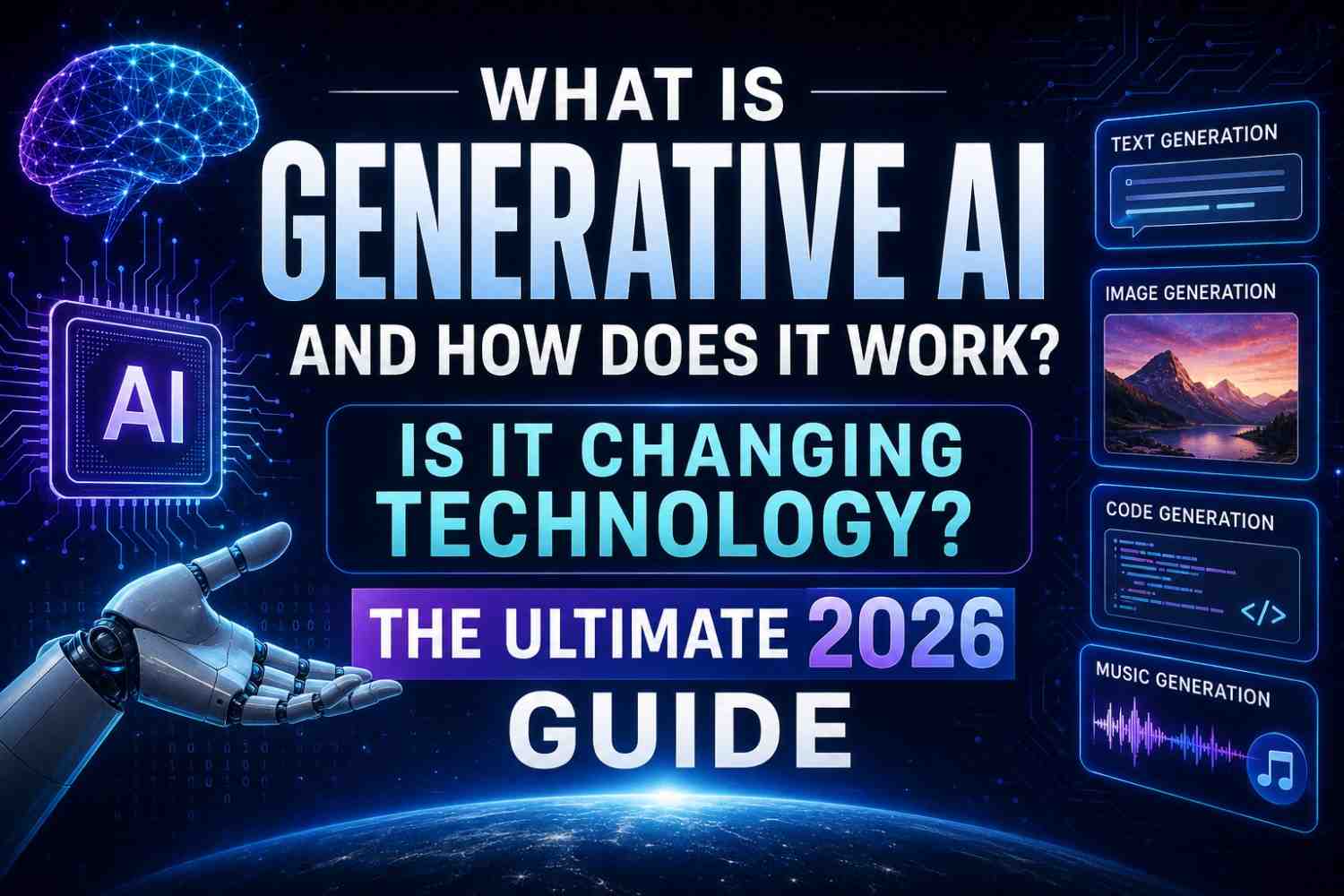
Generative AI refers to artificial intelligence systems that can create new content — text, images, audio, video, code, 3D models — rather than simply analyzing or classifying existing data.
Traditional AI was discriminative: it could look at a photo and say “this is a cat.” Generative AI is creative: it can produce an entirely new image of a cat it has never seen before, in any style, setting, or scenario you describe.
The key word is generate — these systems produce original outputs based on patterns learned from massive datasets.
Also Read :What Is Natural Language Processing? 7 Proven Ways AI Understands Human Speech
What Is Generative AI and How Does It Work? The Core Technology
Large Language Models (LLMs)
For text generation, the dominant technology is the large language model — a transformer-based neural network trained on hundreds of billions of words from books, websites, code repositories, and academic papers.
LLMs work through next-token prediction: given the words you have typed, what word should come next? By training on enormous text corpora, these models develop a deep statistical understanding of language, logic, reasoning, and knowledge.
Examples of LLMs: GPT-4o (OpenAI), Gemini Ultra (Google), Claude 3 Opus (Anthropic), LLaMA 3 (Meta).
Diffusion Models (For Images and Video)
For generating images and video, diffusion models are the current standard. They learn to reverse a noise-corruption process, gradually reconstructing clear images from pure static.
This is the technology behind Midjourney, DALL·E 3, Stable Diffusion, and video tools like Sora.
Generative Adversarial Networks (GANs)
GANs use two competing networks — a generator and a discriminator — to produce realistic outputs. While largely superseded by diffusion models for images, GANs are still used for certain video generation and deepfake applications.
Variational Autoencoders (VAEs)
VAEs encode input data into a compressed representation (latent space) and then decode it back — but with controlled variations. They are used in music generation, molecular design, and drug discovery.
The Training Process: How Generative AI Learns
Understanding what is generative AI and how does it work requires understanding training:
- Data collection — Billions of examples (text, images, audio) are gathered
- Preprocessing — Data is cleaned, tokenized, and formatted
- Pretraining — The model learns general patterns from the full dataset
- Fine-tuning — The model is specialized for specific tasks (e.g., coding, customer service)
- RLHF (Reinforcement Learning from Human Feedback) — Human raters score outputs, teaching the model to be more helpful, accurate, and safe
This process requires enormous computational power. Training GPT-4 reportedly cost over $100 million in compute resources.
Major Categories of Generative AI Tools in 2026
| Category | Leading Tools | Primary Use |
|---|---|---|
| Text Generation | ChatGPT, Claude, Gemini | Writing, coding, Q&A |
| Image Generation | Midjourney, DALL·E 3 | Design, art, marketing |
| Video Generation | Sora, Runway ML, Pika | Film, ads, social content |
| Music Generation | Suno AI, Udio | Songwriting, scoring |
| Code Generation | GitHub Copilot, Cursor | Software development |
| 3D Generation | Meshy, Luma AI | Game design, product modeling |
| Voice Generation | ElevenLabs, HeyGen | Podcasts, avatars, accessibility |
How Generative AI Is Changing Every Industry
Healthcare
Generative AI designs new drug molecules, analyzes medical imaging, summarizes patient records, and assists in surgical planning. Tools trained on genomic data are accelerating personalized medicine.
Education
AI tutors like Khan Academy’s Khanmigo adapt to individual student learning levels. Teachers use generative AI to create lesson plans, quizzes, and personalized study guides.
Marketing and Advertising
Brands now generate entire ad campaigns — copy, visuals, video scripts — in minutes. A/B testing at scale, personalized email campaigns, and dynamic content are all powered by generative AI.
Software Development
GitHub Copilot and Cursor complete code, detect bugs, write documentation, and suggest architecture improvements. Developers report 30–50% productivity gains.
Legal and Finance
AI drafts contracts, summarizes lengthy legal documents, analyzes financial statements, and flags compliance risks. It does not replace lawyers and analysts — it amplifies their capacity.
Entertainment and Media
Screenwriters use AI to develop storylines. Game studios generate NPC dialogue and world-building content. Music composers use AI for harmonic inspiration and arrangement.
Also Read :What Is Natural Language Processing? 7 Proven Ways AI Understands Human Speech
The Ethical Challenges of Generative AI
Understanding what is generative AI and how does it work means acknowledging its serious ethical dimensions:
- Deepfakes — AI-generated video of real people saying or doing things they never did
- Misinformation — Realistic fake news articles and synthetic “evidence”
- Copyright — Training on copyrighted data without consent or compensation
- Job displacement — Roles in writing, design, customer service, and data entry face disruption
- Bias — Models reflect biases present in training data
- Environmental cost — Training and running LLMs consumes significant energy
Responsible use of generative AI requires awareness of these challenges and active support for regulation, transparency, and fair compensation for creators.
Generative AI Regulation in 2026
Governments worldwide have moved to regulate generative AI:
- EU AI Act — Comprehensive regulation requiring transparency, safety testing, and human oversight for high-risk AI systems
- US Executive Orders — Mandating safety evaluations and disclosure for frontier AI models
- China — Requiring AI-generated content to be watermarked and labeled
- UK — Voluntary code of practice for AI developers
These frameworks are shaping how generative AI tools are built and deployed globally.
The Future of Generative AI
Generative AI in 2027 and beyond will likely include:
- Agents — AI that takes multi-step actions autonomously (booking travel, managing projects)
- Multimodal fluency — Seamless switching between text, image, audio, and video
- Personalized models — Custom LLMs trained on your own documents and preferences
- On-device AI — Powerful generative models running locally without internet
- Scientific discovery — AI generating new hypotheses in physics, chemistry, and biology
The trajectory is clear: generative AI will become a fundamental layer of nearly every digital and physical system we interact with.
FAQs: What Is Generative AI and How Does It Work
Q1: What is generative AI in simple terms? Generative AI is a type of artificial intelligence that creates new content — like text, images, music, or code — based on patterns it learned from large datasets.
Q2: What is the most popular generative AI tool in 2026? ChatGPT by OpenAI remains the most widely used, followed closely by Google Gemini and Claude by Anthropic.
Q3: Is generative AI the same as ChatGPT? ChatGPT is one application of generative AI. Generative AI is the broader technology category that includes image, music, video, and code generation tools.
Q4: How is generative AI different from traditional AI? Traditional AI classifies or predicts based on existing data. Generative AI creates entirely new content that did not exist before.
Q5: Can generative AI replace human creativity? It can augment and assist human creativity, but most experts believe truly original human creativity — driven by lived experience and emotion — remains uniquely human.
Q6: Is generative AI safe to use? For general productivity tasks, yes. Users should verify factual claims, avoid sharing sensitive personal data, and be aware of copyright issues when using generated content commercially.
Conclusion
So, what is generative AI and how does it work? It is an extraordinary convergence of deep learning, massive data, and extraordinary computing power — capable of creating content indistinguishable from human output. In 2026, it is no longer a future technology. It is here, it is powerful, and it is changing everything. The question is not whether generative AI will affect your life — it is how you will use it to your advantage. Start by exploring tools like ChatGPT or Claude by Anthropic today.