Introduction
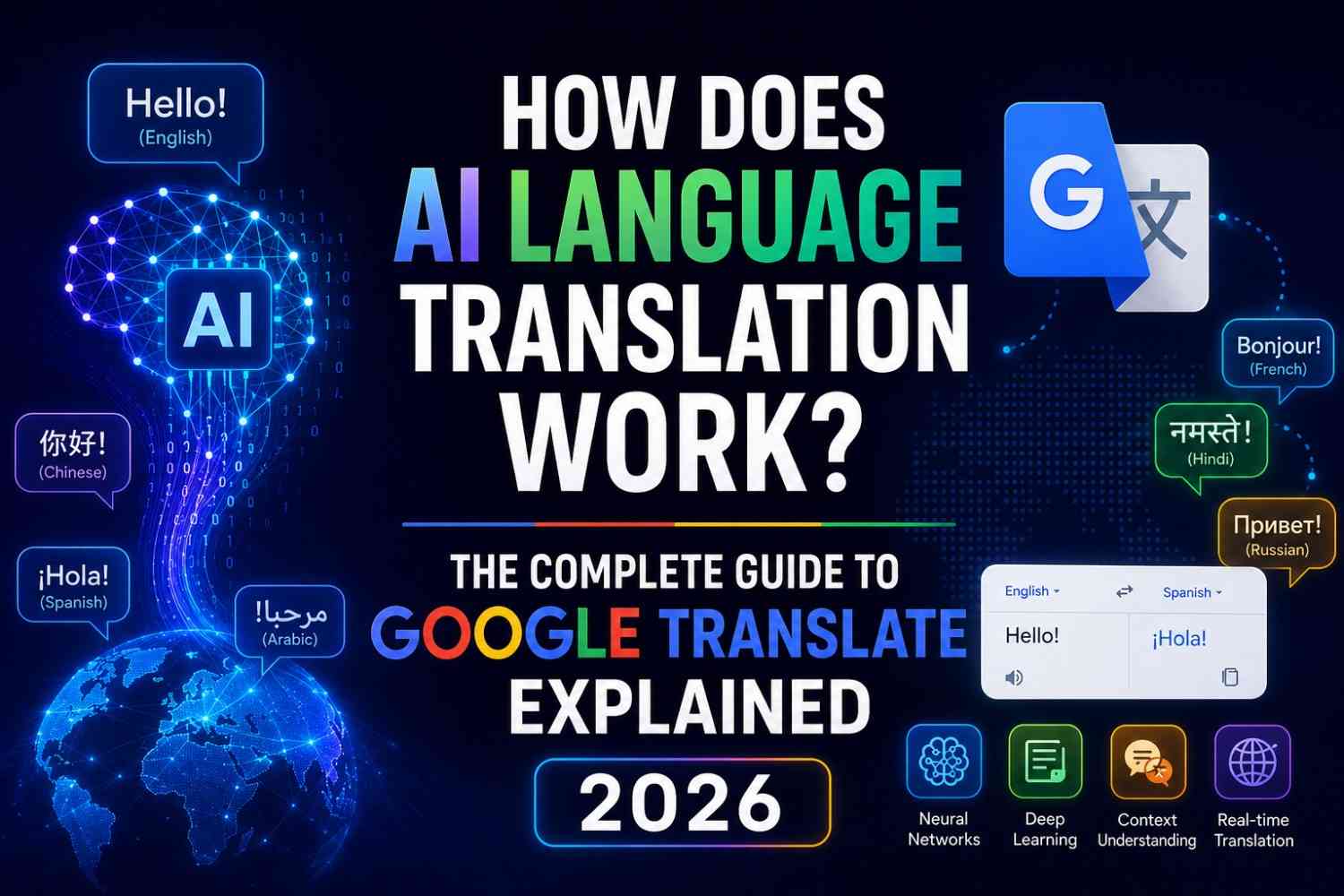
Instant communication across language barriers was once science fiction. Today, you can speak in English and have your words translated into Japanese in under a second. But how does AI language translation work? What technology makes real-time, cross-language communication possible?
From Google Translate to DeepL, AI translation tools have transformed international business, travel, education, and communication. In this guide, we explore the technology, history, and future of AI-powered language translation — and explain why it keeps getting better every year.
A Short History of Machine Translation
Understanding how does AI language translation work begins with its history:
- 1950s — Early rule-based systems translated word-for-word, with poor results
- 1990s — Statistical machine translation (SMT) used probability to guess translations
- 2006 — Google Translate launched using phrase-based SMT
- 2016 — Google switched to Neural Machine Translation (NMT), transforming quality overnight
- 2017 — Transformer architecture launched, further improving NMT
- 2020–2026 — Large language models (LLMs) bring near-human translation quality
The shift from statistical to neural translation was the single biggest improvement in translation quality in history. Google reported that in one update, the quality improvement was equivalent to 10 years of previous progress.
Also Read: How Does Google AI Work? The Complete Guide to Search and Assistant Technology 20
How Does AI Language Translation Work? The Core Technology
Phase 1: Statistical Machine Translation (SMT)
Early Google Translate worked by analyzing billions of translated documents to find statistical patterns. If the phrase “buenos días” appeared opposite “good morning” millions of times in Spanish-English text pairs, the system learned the correlation.
The problem was that SMT was phrase-based. It lacked understanding of grammar structure and produced awkward, unnatural translations.
Phase 2: Neural Machine Translation (NMT)
NMT replaced the statistical approach entirely. Instead of phrase tables, it uses deep neural networks — specifically encoder-decoder architectures.
Here is how it works:
- Encoding — The source sentence is converted into a numerical representation (a vector) that captures its full meaning
- Attention — The model identifies which words in the source most influence each word in the output
- Decoding — The model generates the translated sentence word by word using the encoded meaning
This allows NMT to handle entire sentences holistically, producing much more natural translations.
Phase 3: Transformer-Based Translation
The transformer model — now standard in all leading translation tools — uses multi-head self-attention, allowing the AI to simultaneously consider every word in a sentence relative to every other word.
This is why modern translations understand that “bank” in “river bank” is different from “bank” in “bank account” — it has full sentence context.
How Google Translate Works in Real Time
Google Translate handles over 100 billion words per day across 133 languages. Here is the pipeline for real-time translation:
- Input detection — Google identifies the source language automatically
- Text preprocessing — Punctuation and formatting are normalized
- Neural encoding — The sentence is encoded into a meaning vector
- Beam search decoding — The system generates multiple possible translations simultaneously and selects the highest-probability output
- Post-processing — Grammar and capitalization are corrected
- Output delivery — The translated text appears in under 500 milliseconds
For voice translation, an additional ASR (Automatic Speech Recognition) layer converts your spoken words to text before the translation process begins.
Google Translate vs. DeepL vs. Microsoft Translator
| Feature | Google Translate | DeepL | Microsoft Translator |
|---|---|---|---|
| Languages Supported | 133 | 31 | 110+ |
| Translation Quality | Excellent | Excellent (European langs) | Very good |
| Real-time Voice | Yes | Limited | Yes |
| Offline Support | Yes | Yes (Pro) | Yes |
| API Available | Yes | Yes | Yes |
| Best For | Breadth & travel | European business | Microsoft ecosystem |
DeepL is widely regarded as the highest-quality translator for European languages. Google Translate wins on language breadth and accessibility.
Conversation Mode: Real-Time Two-Way Translation
One of the most remarkable uses of AI translation is Conversation Mode in Google Translate. Two people speaking different languages can hold a real conversation through the app:
- Person A speaks in English
- Google ASR transcribes the speech
- NMT translates it to Spanish instantly
- The translation is spoken aloud
- Person B responds in Spanish, and the process reverses
This technology is already being used in hospitals, airports, emergency services, and classrooms around the world.
Camera and Image Translation
Google Translate’s camera mode uses computer vision combined with NLP to:
- Detect text in an image (using OCR)
- Identify the language
- Translate the text
- Overlay the translated text on the original image in real time
This works for street signs, menus, documents, and product labels — even when you are offline.
Limitations of AI Language Translation
Despite its power, AI translation is not perfect:
- Idioms and slang — “It’s raining cats and dogs” confuses literal translation models
- Low-resource languages — Languages with limited training data (like many African and indigenous languages) produce lower-quality results
- Technical and legal content — Specialized terminology requires human review
- Cultural context — Jokes, poetry, and cultural references often lose meaning
- Tonal languages — Languages like Mandarin and Thai have tonal nuances that are difficult to capture fully
Professional translators remain essential for high-stakes content, legal documents, and literary translation.
Also Read: What Is Natural Language Processing? 7 Proven Ways AI Understands Human Speech
FAQs: How Does AI Language Translation Work
Q1: How does real-time AI translation work? It uses automatic speech recognition to convert speech to text, then neural machine translation to convert text to the target language, then text-to-speech to speak the result.
Q2: What language model does Google Translate use? Google Translate uses a proprietary neural machine translation model based on transformer architecture.
Q3: How accurate is Google Translate in 2026? For major world languages like Spanish, French, German, and Chinese, accuracy is very high — often 90%+ for everyday conversation.
Q4: Can AI replace human translators? For casual and informational content, AI is excellent. For legal, literary, and cultural content, human translators remain essential.
Q5: How does Google Translate detect language automatically? It uses a language identification model trained on thousands of languages that analyzes character patterns, word frequency, and grammar signals.
Q6: Does Google Translate work offline? Yes. You can download language packs for offline translation, though quality is slightly lower than the online model.
Conclusion
Understanding how does AI language translation work reveals one of technology’s most impressive achievements. What once required years of language study can now happen in milliseconds, breaking down barriers between cultures and enabling global communication. Whether you are a traveler, a business professional, or simply curious — tools like Google Translate and DeepL are worth exploring deeply. The world just got a lot smaller.