Introduction
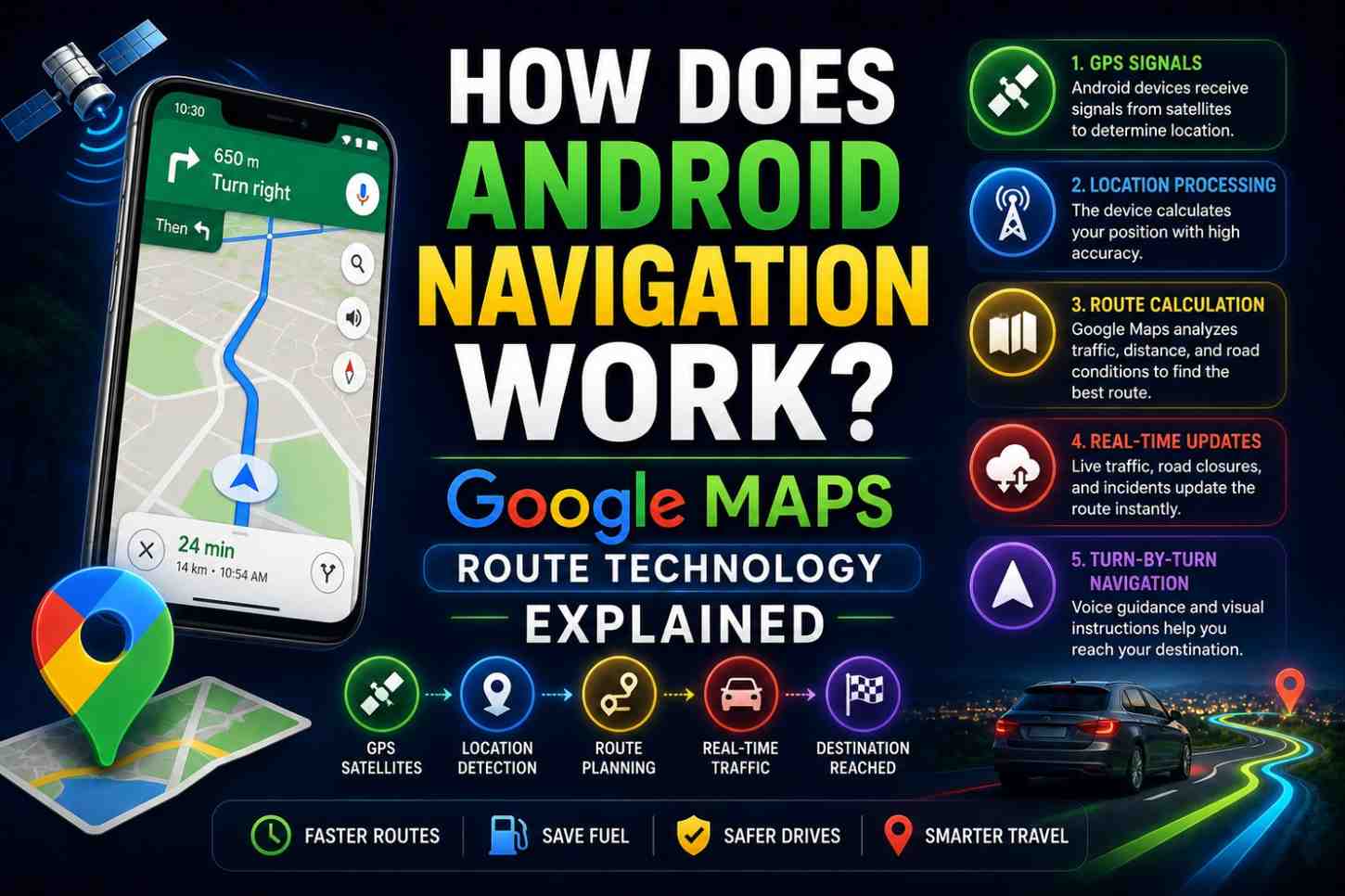
You open Google Maps, tap a destination, and your phone knows exactly where you are on the planet — accurate to within a few meters. But how does GPS work on phones, really? What is happening inside your device in those few seconds before the blue dot appears?
Most people assume GPS is simple. In reality, it is one of the most sophisticated technologies ever deployed — involving satellites orbiting 20,000 kilometers above Earth, atomic clocks accurate to one billionth of a second, and a tiny chip inside your phone doing complex mathematics in real time. In this guide, we reveal the complete story behind phone GPS — including seven facts that will genuinely surprise you.
What Is Phone GPS and How Does It Work?
GPS stands for Global Positioning System. It is a satellite-based navigation system originally developed by the United States Department of Defense in the 1970s and made available for civilian use in the 1980s.
Your smartphone contains a dedicated GPS chip — a small receiver that listens for radio signals broadcast continuously by GPS satellites orbiting Earth. By analyzing the signals from multiple satellites simultaneously, your phone calculates its precise position on Earth’s surface.
Understanding how does GPS work on phones requires grasping one key idea: GPS is entirely about time. The satellites do not know where you are. They just broadcast the time — incredibly precisely. Your phone does all the location math.
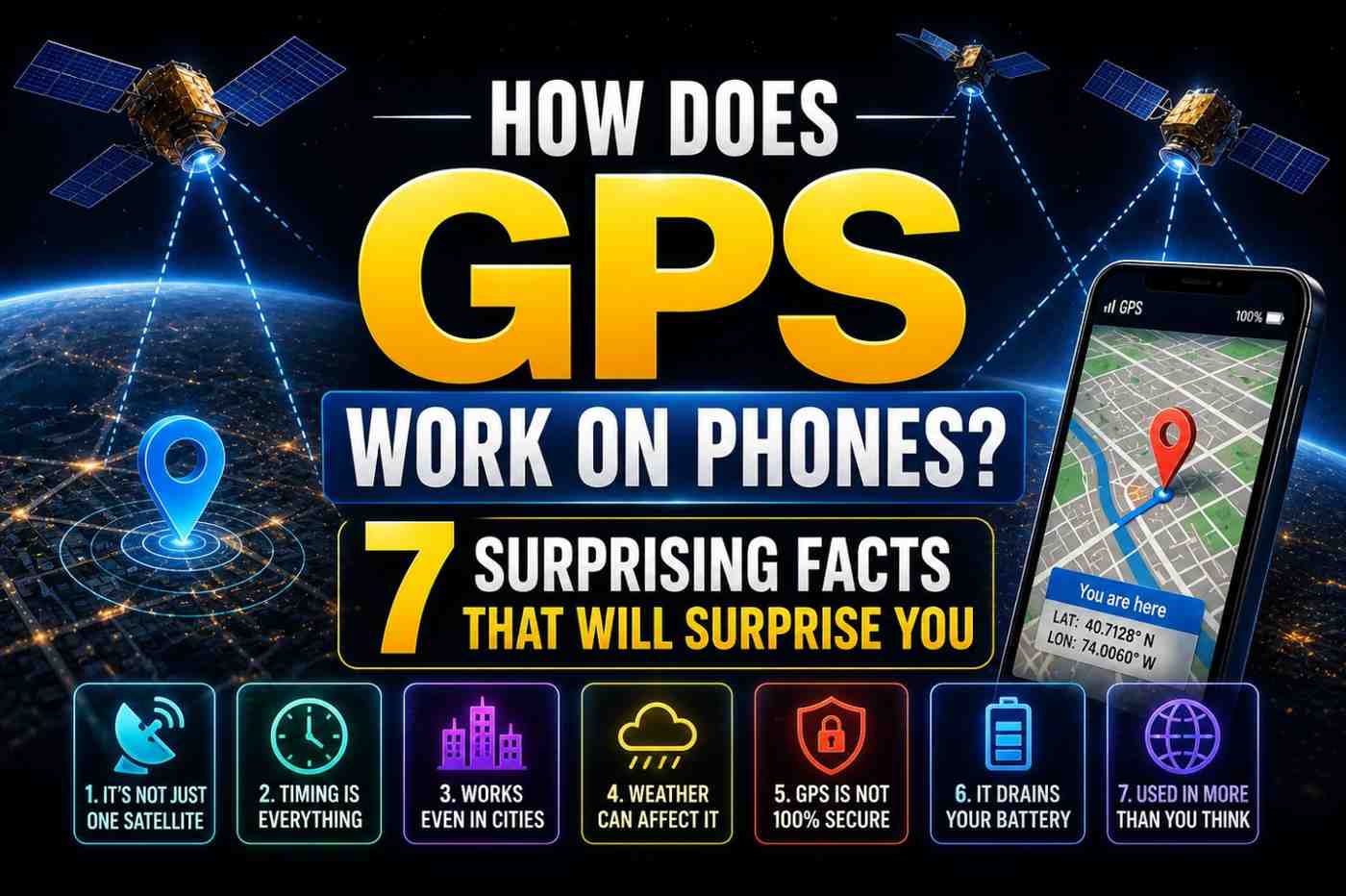
The 7 Surprising Facts About How GPS Works on Phones
Fact 1: Your Phone Only Receives — It Never Transmits to Satellites
This surprises almost everyone. Your phone’s GPS chip is a passive receiver only. It receives signals from satellites but never sends anything back. The satellites have absolutely no idea you exist.
This means:
- GPS works for unlimited users simultaneously with no network congestion
- GPS does not drain your mobile data (satellite signals are free)
- GPS cannot be “tracked” by satellites — only by apps with permission to access your GPS chip
Fact 2: GPS Signals Travel at the Speed of Light and Time Is Everything
GPS satellites broadcast a continuous signal containing two pieces of information:
- The satellite’s exact orbital position
- The precise time the signal was sent (from an atomic clock accurate to one nanosecond)
Your phone records when each signal arrives. The difference between send time and receive time — multiplied by the speed of light (299,792 km/s) — gives the exact distance to that satellite.
This process is called pseudorange calculation, and it happens continuously across multiple satellites simultaneously.
Fact 3: You Need at Least 4 Satellites for a 3D Fix
Three satellites can give you a 2D position (latitude and longitude). But to also determine altitude — and to correct for timing errors in your phone’s less-precise internal clock — you need signals from at least four satellites.
In practice, modern GPS chips receive signals from 8–12 satellites at once for maximum accuracy.
Fact 4: The GPS Chip in Your Phone Uses Almost No Power on Its Own
The GPS chip itself is extremely power-efficient — consuming less than 25 milliwatts during active navigation. What drains your battery during navigation is the screen, cellular radio, and apps running simultaneously — not the GPS receiver itself.
Fact 5: GPS Signals Are Incredibly Weak — Weaker Than a Light Bulb Seen From Space
The radio signals from GPS satellites are extraordinarily faint by the time they reach your phone — about 10^-16 watts (0.0000000000000001 watts). This is equivalent to the light from a 25-watt bulb viewed from 15,000 kilometers away.
Your phone’s GPS chip contains highly sensitive amplifiers and sophisticated signal processing to detect and decode these incredibly weak signals.
Fact 6: Buildings, Trees, and Your Body Block GPS Signals
GPS signals are line-of-sight radio waves. They pass through clouds and weather easily — but solid materials block or degrade them significantly:
- Buildings cause multipath errors (signals bouncing off surfaces before reaching your phone)
- Dense tree canopy attenuates signal strength
- Your hand covering the GPS antenna area can reduce accuracy noticeably
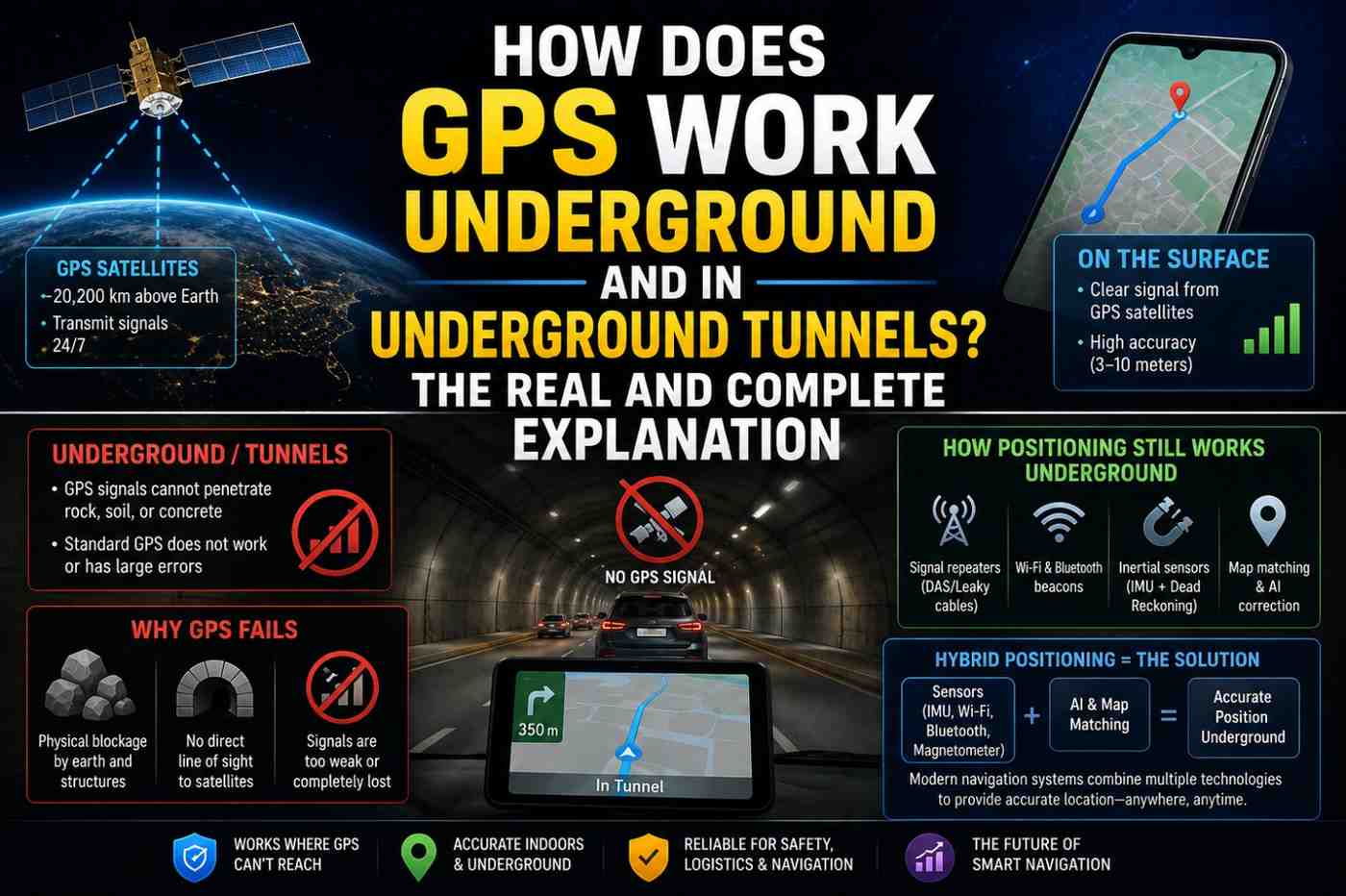
- Indoor environments often make GPS unusable — which is why phones switch to Wi-Fi and cell positioning indoors
Fact 7: Your Phone Uses GPS Plus Three Other Technologies Simultaneously
Pure GPS alone is relatively slow and struggles indoors. Modern smartphones use a hybrid positioning system combining:
- GPS — satellite signals for outdoor precision
- A-GPS (Assisted GPS) — cell network data to speed up satellite acquisition
- Wi-Fi positioning — nearby Wi-Fi networks for indoor/urban location
- Cell tower triangulation — coarse location from cellular networks
- Accelerometer and gyroscope — dead reckoning when satellite signals are lost
This hybrid approach is why your phone knows your approximate location almost instantly, even before GPS satellites are locked.
Also Read :What Is Natural Language Processing? 7 Proven Ways AI Understands Human Speech
The GPS Chip Inside Your Phone
Most modern Android smartphones use GPS chips from Qualcomm (integrated into Snapdragon processors), Broadcom, or MediaTek. Apple’s iPhones use Apple-designed chips with integrated GPS.
Modern GPS chips support not just the US GPS constellation but also:
- GLONASS — Russia’s satellite navigation system
- Galileo — European Union’s system
- BeiDou — China’s system
- NavIC — India’s regional system (newer Qualcomm chips)
Receiving signals from multiple constellations simultaneously — called multi-constellation GNSS — significantly improves accuracy and reliability, especially in urban areas.
How Long Does GPS Take to Lock On?
GPS lock-on time depends on the phone’s current state:
| Situation | Lock-On Type | Typical Time |
|---|---|---|
| Last used recently (same area) | Hot start | 1–5 seconds |
| Not used for hours | Warm start | 15–30 seconds |
| First use or far from last location | Cold start | 1–5 minutes |
| A-GPS data available | Assisted | Under 5 seconds always |
A-GPS dramatically reduces cold start times by downloading satellite almanac data from the internet rather than waiting to receive it directly from satellites.
GPS Accuracy on Modern Smartphones
Consumer GPS on smartphones typically achieves accuracy of 3–5 meters under good conditions. Factors that affect accuracy:
- Number of satellites in view
- Satellite geometry (spread across the sky is better)
- Atmospheric conditions (ionospheric delay)
- Multipath interference from buildings
- Quality of the GPS chip
- Whether dual-frequency GPS is supported
Premium smartphones with dual-frequency GPS (L1 + L5 bands) can achieve accuracy of 1–2 meters — eliminating many urban canyon errors.
Also Read :What Is Natural Language Processing? 7 Proven Ways AI Understands Human Speech
FAQs: How Does GPS Work on Phones
Q1: How does GPS work on phones without an internet connection? GPS satellites broadcast signals for free, and your phone receives them without internet. However, map data for navigation typically requires an internet connection unless downloaded offline.
Q2: Does GPS use mobile data? The GPS signal itself is free and uses no mobile data. Apps like Google Maps use data to download map tiles and real-time traffic, but the positioning signal is satellite-based.
Q3: Why does my phone GPS sometimes show the wrong location? Multipath interference, weak satellite signals, atmospheric delay, or the phone relying on less-accurate cell tower positioning can all cause location errors.
Q4: Does GPS work in airplane mode? Yes. GPS is a receive-only technology and works in airplane mode. However, A-GPS assistance and map data require an internet connection.
Q5: Which smartphone has the most accurate GPS? Flagship phones with dual-frequency GPS (L1+L5) — including recent Google Pixel, Samsung Galaxy S series, and iPhone 15/16 models — offer the best accuracy.
Q6: Can GPS work underground or in tunnels? Not directly. GPS requires line-of-sight to satellites. Underground, phones use dead reckoning (sensors) and Wi-Fi/Bluetooth positioning as fallbacks.
Conclusion
Now you know the full story of how does GPS work on phones — from space-based atomic clocks to the hybrid positioning chip in your pocket. What seems like a simple blue dot on a map is actually the result of extraordinary physics, engineering, and mathematics working together in real time. The next time your phone pinpoints you on Earth in under three seconds, you will know exactly how remarkable that really is. Explore your phone’s GPS performance with apps like GPS Test or check Google’s location technology at Google Maps Platform.