Introduction
One day your website is ranking beautifully. Next, traffic has dropped by 40% overnight—and you did not change a thing. Welcome to the world of Google algorithm updates. But how does Google’s algorithm work, and why do these updates cause such dramatic shifts?
Google’s algorithm is not a single piece of code. It is a constantly evolving, AI-powered system of interconnected ranking signals, quality filters, and behavioral models—updated thousands of times per year. Understanding how it works is essential for anyone who relies on Google traffic. In this guide, we break down the algorithm clearly, explain the most important updates, and show you how to build a site that thrives regardless of what Google changes next.
Read Also: What Is SEO and How Does It Work?
What Is Google’s Algorithm?
Google’s algorithm is the set of rules, signals, and machine learning systems that Google uses to determine which web pages rank in which positions for any given search query.
It processes:
- The meaning of the search query
- The relevance and quality of potential results
- The authority and trustworthiness of sources
- The user experience on candidate pages
- The personalization factors for the specific user
The algorithm runs billions of times per day, instantaneously, producing unique ranked results for every unique search.
How Does Google’s Algorithm Work? The Core Components
Component 1: Crawling and Indexing Pipeline
The algorithm begins with data. Googlebot crawls the web, and indexing systems process and store page information. Without this foundation, there is nothing to rank.
Component 2: Query Understanding
When a user searches, the algorithm first decodes what they really want:
- What type of content best satisfies this query? (article, video, product, local result)
- Is this query time-sensitive?
- What geography is relevant?
- What is the user’s likely intent?
Component 3: Matching and Ranking
The algorithm retrieves relevant candidates from the index and applies hundreds of ranking signals to sort them. These signals are grouped into:
- Relevance signals—keyword presence, semantic match, topic coverage
- Authority signals—PageRank, referring domains, brand strength
- Quality signals—E-E-A-T evaluation, content depth, accuracy
- Experience signals—Core Web Vitals, mobile performance, security
Component 4: Spam Detection
Before results are served, SpamBrain—Google’s AI spam detection system—filters out pages that violate Google’s spam policies, including:
- Keyword stuffing
- Hidden text or links
- Cloaking (showing different content to users and bots)
- Purchased link schemes
- Auto-generated low-quality content
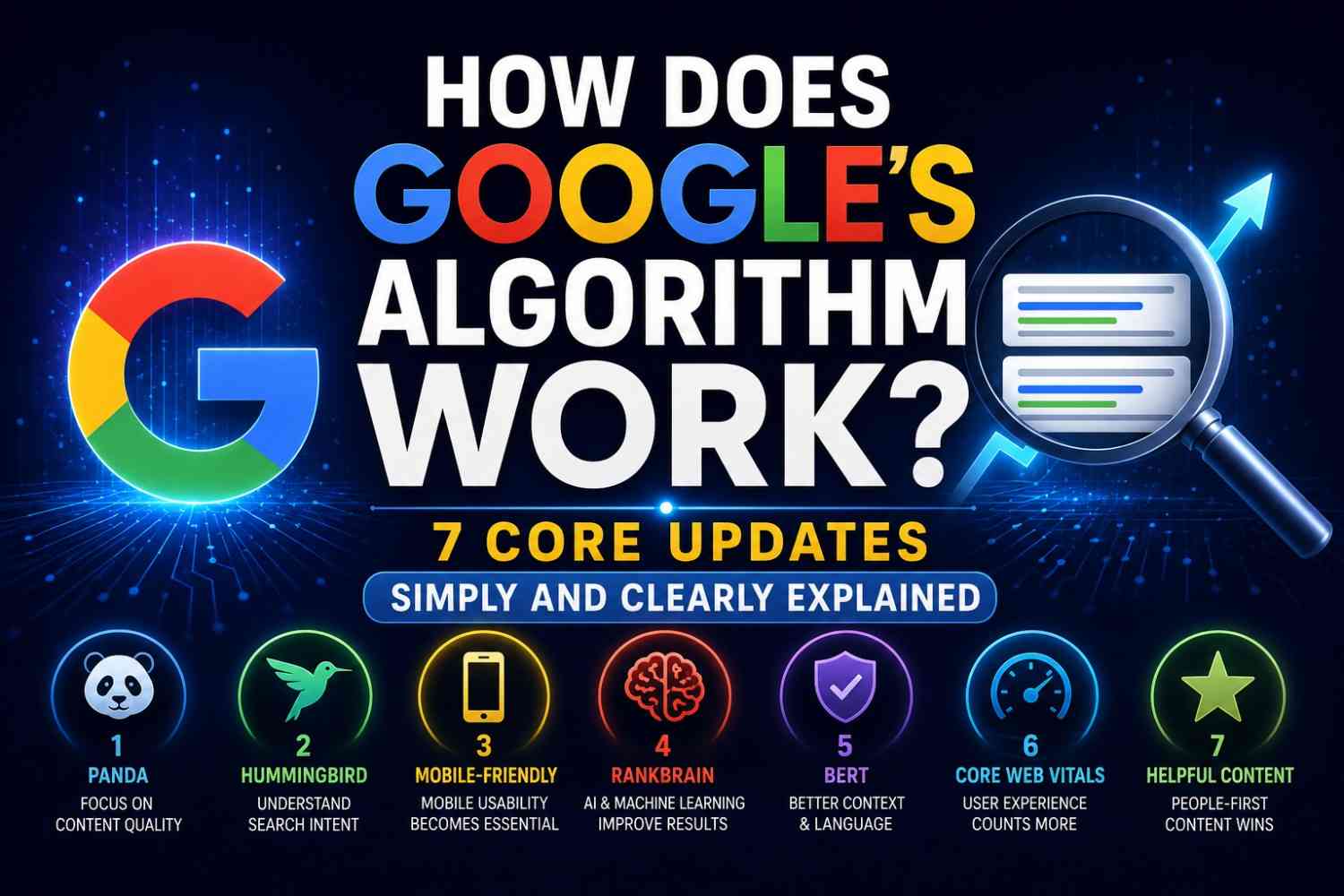
The 7 Most Important Google Algorithm Updates Explained
Update 1: Google Panda (2011)
What it did: Targeted low-quality content—thin pages, content farms, duplicate content, and over-optimized keyword-stuffed articles.
Impact: Millions of websites with shallow content lost significant rankings overnight.
Lesson: Every page on your site contributes to your overall quality perception. Remove or improve thin content.
Update 2: Google Penguin (2012)
What it did: Targeted manipulative link building—paid links, link networks, and unnatural anchor text patterns.
Impact: Websites that had built rankings through link schemes were penalized or deindexed.
Lesson: Build links naturally through quality content and genuine outreach. Avoid any form of paid or manipulative link schemes.
Update 3: Google Hummingbird (2013)
What it did: Introduced semantic search—understanding the meaning and intent behind queries, not just matching keywords.
Impact: Conversational and long-tail queries became much better served. Keyword stuffing became even less effective.
Lesson: Write for humans and topics, not just keyword repetition.
Update 4: RankBrain (2015)
What it did: Added machine learning to Google’s core ranking algorithm. RankBrain interprets ambiguous queries by mapping them to patterns learned from billions of past searches.
Impact: Google became dramatically better at understanding never-before-seen queries.
Lesson: Optimize for topics and comprehensive answers, not just individual keyword phrases.
Update 5: BERT (2019)
What it did: Applied transformer-based natural language understanding to both queries and pages. BERT reads full sentence context, understanding word meaning in relation to surrounding words.
Impact: Complex, conversational queries became much better served. About 10% of all queries were immediately improved.
Lesson: Write in natural, clear language. Use proper sentence structure and logical flow.
Update 6: Helpful Content System (2022–2023)
What it did: Introduced a site-wide signal that rewards content written primarily for human readers and penalizes content created primarily to rank.
Impact: Websites built primarily around SEO tactics without genuine value saw significant traffic drops. Sites with authentic, experience-driven content gained traction.
Lesson: Create content that demonstrates first-hand experience, genuine expertise, and real value. Write for your reader, not for Googlebot.
Update 7: Core Updates (Ongoing — 2024–2026)
What they do: Regular broad core algorithm updates recalibrate how Google’s systems weight various signals. They are not targeting specific tactics—they are reassessing overall quality evaluation.
Impact: Some sites gain, some sites lose. Recovery from core update drops requires genuine, systemic content improvement—not quick fixes.
Lesson: There is no shortcut to surviving core updates. Build a site that genuinely serves its audience better than the competition.
How Often Does Google Update Its Algorithm?
Google makes thousands of minor updates per year—most go unnoticed. The ones that matter most:
| Update Type | Frequency | Impact Level |
|---|---|---|
| Broad Core Updates | 3–5 per year | Very high |
| Spam Updates | 1–3 per year | High (for affected sites) |
| Product Reviews Updates | 2–3 per year | Moderate |
| Daily tweaks | Constant | Usually low |
Monitoring tools like Google Search Console, Semrush Sensor, and MozCast can detect ranking volatility that signals a major update.
How to Build a Site That Survives Algorithm Updates
The websites that consistently survive—and benefit from—algorithm updates share the same characteristics:
- Genuine expertise — Content written by knowledgeable people with real experience
- Original research and data—something that cannot be found elsewhere
- Comprehensive coverage—Thoroughly answering the topic, not just skimming it
- Excellent user experience—fast, mobile-friendly, easy to navigate
- Clean link profile—Natural, relevant, earned backlinks
- Transparent authorship — Clear author information and credentials
- Regular content maintenance—updating older content to keep it accurate
FAQs: How Does Google’s Algorithm Work
Q1: How does Google’s algorithm work in simple terms? It analyzes web pages using hundreds of signals—including relevance, authority, content quality, and user experience—to determine the best results for each specific search query.
Q2: How many updates does Google make per year? Google makes thousands of small updates and several major core updates per year. The biggest ones are officially confirmed on the Google Search Status Dashboard.
Q3: How do I know if my site was hit by a Google algorithm update? Monitor your organic traffic in Google Analytics and Search Console. A significant traffic drop around a confirmed update date typically indicates impact.
Q4: Can I recover from a Google algorithm penalty? Yes. For algorithmic demotions (not manual penalties), improving content quality, removing thin pages, and earning better backlinks can restore rankings over subsequent updates.
Q5: Is there a way to predict what Google will update next? Not precisely. However, Google consistently signals its priorities through documentation, public statements, and the Search Quality Rater Guidelines.
Q6: Does Google penalize AI-generated content? Google penalizes low-quality content regardless of how it was made. AI-generated content that is genuinely helpful, accurate, and original can rank well.
Conclusion
Understanding how Google’s algorithm works transforms your relationship with SEO from reactive panic to proactive strategy. Google’s updates always move in the same direction: toward rewarding genuine quality, real expertise, and true user satisfaction. The sites that win long-term are not those chasing algorithm tricks—they are those committed to being genuinely the best answer for their audience. Stay informed with the Google Search Status Dashboard and dig deeper into quality guidelines at the Google Search Quality Rater Guidelines.