Introduction: What is Machine Learning and What is Deep Learning
In today’s AI-driven world, terms like “machine learning” and “deep learning” are thrown around constantly. But while many people use these terms interchangeably, they’re actually quite different. Understanding the deep learning vs machine learning difference is essential for anyone working with data, developing AI applications, or simply trying to understand the technology shaping our world.
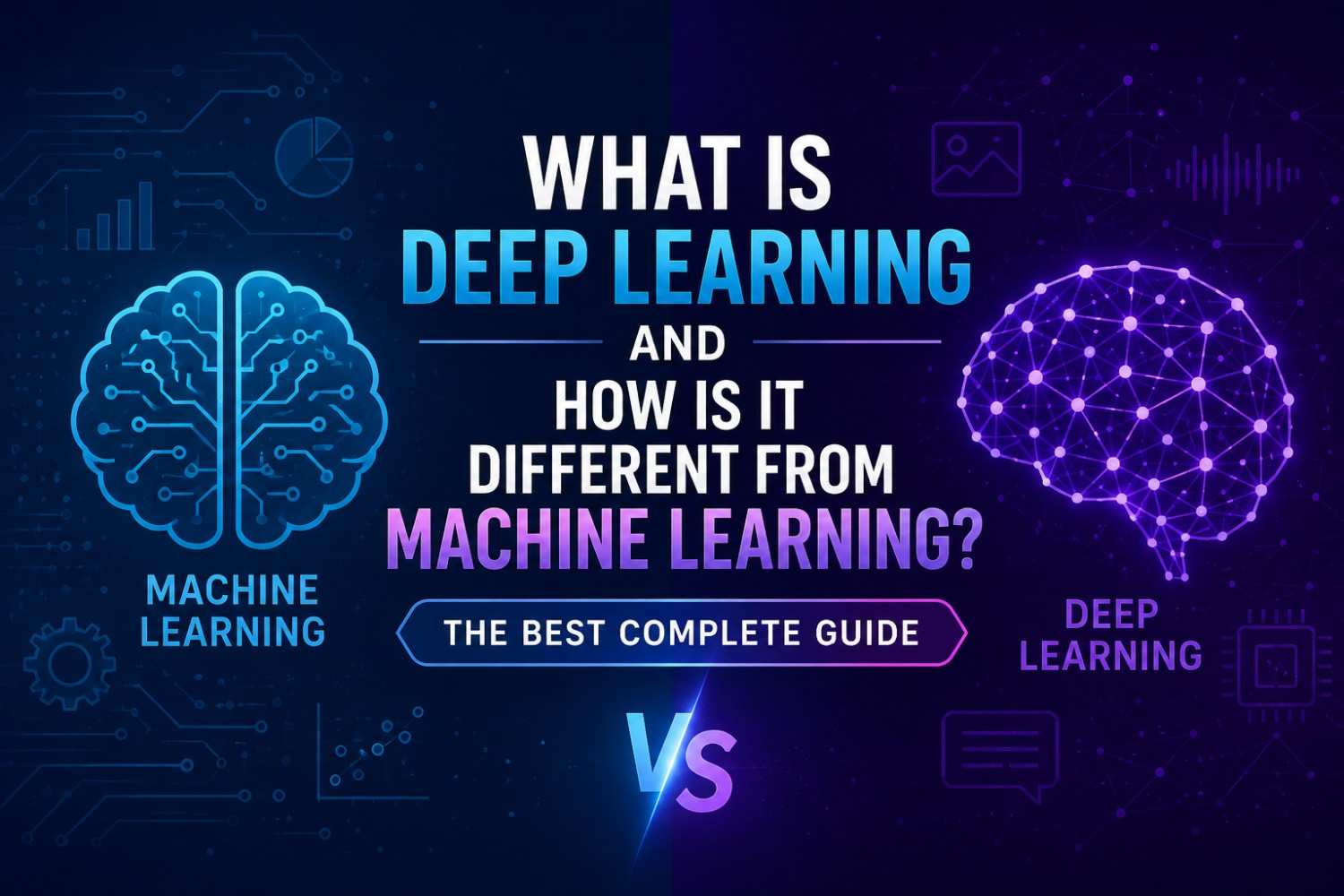
The confusion is understandable. Deep learning is actually a subset of machine learning, so the relationship between them is hierarchical rather than oppositional. However, the deep learning vs machine learning difference is significant enough that these technologies require different approaches, resources, and expertise.
This comprehensive guide will break down exactly what machine learning and deep learning are, explore their key differences, examine when each is most appropriate, and help you understand which technology is right for different problems. By the end, you’ll have a clear grasp of how machine learning differs from deep learning and be able to make informed decisions about which to use.
What Is Machine Learning? Foundations and Fundamentals
Defining Machine Learning
Machine learning is a branch of artificial intelligence that enables computers to learn from data without being explicitly programmed. Instead of following step-by-step instructions, machine learning systems improve their performance on a task by analyzing patterns in training data.
The fundamental idea is elegant: show a computer system many examples, and it learns the underlying patterns that distinguish between different categories or predict outcomes. As the system encounters more examples, it refines its understanding and becomes more accurate.
How Machine Learning Works: The Basic Process
Machine learning follows a systematic process:
Step 1: Data Collection – Gather examples relevant to the problem. If you want to predict whether an email is spam, you collect thousands of emails labeled as spam or legitimate.
Step 2: Feature Engineering – Identify and extract the relevant characteristics (features) from your data. For an email, features might include sender information, word frequency, presence of links, and message length.
Step 3: Model Selection – Choose an algorithm that will learn from these features. Common algorithms include decision trees, random forests, support vector machines, and logistic regression.
Step 4: Training – Feed the labeled examples to the algorithm. It analyzes the features and learns the patterns that distinguish categories.
Step 5: Validation – Test the trained model on data it hasn’t seen before to verify it works correctly.
Step 6: Deployment – Use the trained model to make predictions on new, unlabeled data.
Types of Machine Learning
Understanding different machine learning approaches helps clarify the deep learning vs machine learning difference:
Supervised Learning: The algorithm learns from labeled examples where the correct answer is provided. Predicting house prices from features like size and location is supervised learning.
Unsupervised Learning: The algorithm finds patterns in unlabeled data without being told what to look for. Clustering customers into groups based on purchasing behavior is unsupervised learning.
Reinforcement Learning: The algorithm learns by receiving rewards or penalties for actions, gradually discovering the best strategy. This is how computers learn to play games like chess or Go.
Semi-supervised Learning: Combines labeled and unlabeled data to improve learning efficiency when labeled data is expensive or scarce.
Common Machine Learning Algorithms
- Decision Trees: Create flowchart-like models by splitting data based on feature values
- Random Forest: Combine multiple decision trees for better accuracy and robustness
- Support Vector Machines (SVM): Find optimal boundaries separating different categories
- Naive Bayes: Use probability to make predictions based on feature independence
- Linear Regression: Predict continuous values by fitting a line through data
- Logistic Regression: Predict binary outcomes using probability
- K-Means Clustering: Group data into K clusters without labels
Also Read :What Is Natural Language Processing? 7 Proven Ways AI Understands Human Speech
What Is Deep Learning? Understanding Neural Networks
Defining Deep Learning
Deep learning is a specialized subset of machine learning that uses artificial neural networks with multiple layers to learn hierarchical representations of data. The term “deep” refers to the multiple layers (often 10, 50, or even 1000+ layers) in these neural networks.
Where traditional machine learning relies on humans to engineer features, deep learning automatically learns what features to look for at each layer of the network. This automatic feature learning is the primary distinction in the deep learning vs machine learning difference.
Neural Networks: The Foundation of Deep Learning
A neural network is inspired by how biological brains work. It consists of:
Neurons (Nodes): Mathematical units that process input information and produce output. Each neuron receives inputs, multiplies them by weights, adds a bias term, and passes the result through an activation function.
Layers: Neurons are organized in layers:
- Input Layer: Receives raw data
- Hidden Layers: Process information, extracting increasingly complex features
- Output Layer: Produces the final prediction or classification
Connections (Weights): Links between neurons have associated weights that determine how much each input influences the neuron’s output. These weights are learned during training.
Activation Functions: These introduce non-linearity, allowing neural networks to learn complex, non-linear relationships. Common activation functions include ReLU, sigmoid, and tanh.
How Deep Learning Works
During training, a deep learning system:
- Receives input data (like an image of a cat)
- Passes it through the input layer to the first hidden layer
- The first layer extracts low-level features (edges, colors)
- Subsequent layers combine these into more complex features (shapes, textures)
- Deeper layers recognize high-level features (eyes, whiskers)
- The output layer produces the final classification (cat or not cat)
This hierarchical learning of features is automatic—you don’t tell the network what features to look for. It discovers them through training.
Types of Neural Networks
Different architectures excel at different tasks:
Feedforward Neural Networks: Information flows in one direction from input to output. The simplest type but effective for many tasks.
Convolutional Neural Networks (CNNs): Specialized for image and spatial data. Use filters that scan across images to detect features at different positions.
Recurrent Neural Networks (RNNs): Process sequences of data like text or time series. Have connections that loop back, allowing them to maintain memory of previous inputs.
Long Short-Term Memory Networks (LSTMs): Advanced RNNs that can remember long-term dependencies, solving the vanishing gradient problem.
Transformers: Revolutionary architecture using attention mechanisms, now the foundation of large language models like ChatGPT.
Generative Adversarial Networks (GANs): Pair two networks (generator and discriminator) in competition to create realistic synthetic data.
Deep Learning vs Machine Learning Difference: Key Distinctions
Understanding the Relationship
The most fundamental point about the deep learning vs machine learning difference is that deep learning is a subset of machine learning. All deep learning systems are machine learning systems, but not all machine learning systems are deep learning systems.
Think of it as a hierarchy:
- Artificial Intelligence (broad field)
- Machine Learning (subset of AI)
- Deep Learning (subset of machine learning)
- Machine Learning (subset of AI)
Feature Engineering: Manual vs Automatic
This is arguably the most important deep learning vs machine learning difference.
Machine Learning: Requires human experts to identify and engineer relevant features. A data scientist must decide which characteristics matter. For detecting fraud, they might engineer features like transaction size, merchant type, time of day, and historical patterns. This process requires domain expertise and is time-consuming.
Deep Learning: Automatically learns features at different levels of abstraction. You give it raw data, and the network figures out which features matter. For fraud detection, you provide transaction data directly, and the network learns to extract relevant features through its layers.
This automatic feature learning is why deep learning excels with raw, unstructured data like images and text.
Data Requirements: Quantity Matters
A crucial deep learning vs machine learning difference is data quantity needs.
Machine Learning: Works effectively with smaller datasets. A random forest can make good predictions with thousands or tens of thousands of examples. Since humans engineer the features, the algorithm doesn’t need as many examples to learn patterns.
Deep Learning: Typically requires much larger datasets—often millions of examples. Deep networks have millions of parameters to learn, so they need abundant data to avoid overfitting (memorizing training data rather than learning generalizable patterns).
However, when abundant data is available, deep learning usually outperforms traditional machine learning because it can learn more complex patterns.
Computational Resources: Power Requirements
The deep learning vs machine learning difference extends to hardware requirements:
Machine Learning: Can run on standard computers and laptops. Training a random forest or SVM takes seconds to minutes. CPU processing is usually sufficient.
Deep Learning: Often requires specialized hardware. GPUs (graphics processing units) and TPUs (tensor processing units) dramatically accelerate training by parallelizing computations across thousands of cores. Training large deep networks can take hours, days, or weeks even on powerful hardware.
This makes deep learning more resource-intensive and expensive to implement.
Interpretability: Understanding Why
A significant deep learning vs machine learning difference is transparency.
Machine Learning: More interpretable and transparent. You can often understand why a decision tree made a specific decision by following its branches. Feature importance scores tell you which inputs matter most.
Deep Learning: Often called a “black box.” With thousands of layers and millions of parameters, it’s difficult to understand why the network made a specific prediction. This lack of interpretability is problematic in domains like healthcare or criminal justice where explainability is critical.
Recent research into explainable AI is improving this situation, but traditional machine learning remains more transparent.
Model Complexity and Flexibility
Machine Learning: Generally simpler models with fewer parameters. A logistic regression model has just a few weights to learn. This simplicity means they’re less prone to overfitting and often faster to train.
Deep Learning: Highly complex models with tremendous flexibility. A deep neural network can learn almost any pattern given sufficient data. This flexibility is powerful but also risky—without proper safeguards, the network might learn spurious patterns rather than true relationships.
Comparing Feature Engineering Requirements
Machine Learning Feature Engineering
Machine learning success heavily depends on feature engineering. Consider predicting house prices:
A machine learning system might require manually engineered features like:
- Square footage
- Number of bedrooms and bathrooms
- Lot size
- Age of house
- Distance to school
- Neighborhood characteristics
- Local crime rates
Creating these features requires domain expertise. A real estate expert knows which factors matter. Extracting and calculating these from raw data takes significant effort.
Deep Learning Automatic Feature Learning
A deep learning system accepts raw data directly—like property images and descriptions—and learns relevant features automatically.
For image data, different layers learn:
- Layer 1: Edges and colors
- Layer 2: Simple shapes and textures
- Layer 3: Architectural elements (windows, doors)
- Layer 4: House features (condition, style)
- Later layers: Abstract concepts relevant to price
This automatic progression from simple to complex features is powerful for unstructured data.
When Manual Feature Engineering Wins
For structured, tabular data with few features, carefully engineered features often outperform deep learning:
- Healthcare datasets with patient characteristics
- Financial data for credit scoring
- Customer data for purchasing predictions
- Inventory data for demand forecasting
In these cases, domain expertise yields better performance with less data and computation.
When Automatic Feature Learning Wins
Deep learning excels when features are obvious to a neural network but hard to engineer manually:
- Images and computer vision tasks
- Audio and speech recognition
- Natural language processing and text
- Time series with complex temporal patterns
- Sensor data from IoT devices
Data Quantity and Processing Power
The Data Threshold
A critical deep learning vs machine learning difference is when each approach becomes viable:
Machine Learning Performance: Often plateaus around 10,000 to 100,000 examples. Additional data provides diminishing returns.
Deep Learning Performance: Improves dramatically as data increases. With millions of examples, deep learning typically surpasses machine learning. With billions of examples (like language models trained on the entire internet), the gap becomes substantial.
The relationship isn’t arbitrary. Deep networks have more parameters to learn. A deep CNN might have 50 million parameters. To reliably learn 50 million parameters without overfitting, you typically need millions of training examples.
GPU and TPU Acceleration
Machine learning algorithms benefit from faster processors but don’t require specialized hardware. A decision tree runs fine on any computer.
Deep learning demands computational acceleration:
GPUs (Graphics Processing Units): Originally designed for graphics, GPUs excel at parallel computations that deep learning requires. A modern GPU has thousands of cores processing simultaneously. Training a large neural network on GPU takes hours instead of weeks on CPU.
TPUs (Tensor Processing Units): Google’s specialized chips for deep learning, optimized specifically for neural network operations. Even faster than GPUs for many tasks.
Cloud Computing: AWS, Google Cloud, and Azure provide on-demand GPU access, making deep learning accessible without massive capital investment.
Cost-Benefit Analysis
The deep learning vs machine learning difference in computational costs is significant:
Machine Learning: Training often costs $0-100. You can train models on your laptop. Deployment requires minimal resources.
Deep Learning: Training large models costs thousands to millions of dollars in computing resources. Deploying also requires substantial infrastructure.
This cost differential matters for organizations. If machine learning solves your problem well, why pay more for deep learning?
Interpretability and Transparency Issues
Why Interpretability Matters
In regulated industries, understanding model decisions is essential:
Healthcare: If a model denies insurance, patients deserve to know why. Finance: Loan denials require explanations under regulations like Fair Credit Reporting Act. Criminal Justice: Algorithmic risk assessments influence sentencing and parole decisions. Employment: Hiring algorithms can’t just say “no” without explanation.
The deep learning vs machine learning difference in interpretability is profound.
Machine Learning Interpretability
Traditional machine learning offers several explanation methods:
Decision Trees: You can follow the path through the tree. “The system approved your loan because your credit score exceeded 700, your debt-to-income ratio was below 0.4, and you had 5+ years employment history.”
Feature Importance: Shows which features influenced predictions. “Income and credit score were the most important factors; employment history was also considered.”
Rule-Based Models: Simple if-then rules. “If credit score > 750 and income > $50,000, approve the loan.”
Logistic Regression Coefficients: Show direction and magnitude of relationships. “A higher credit score increases approval probability.”
Deep Learning Interpretability Challenges
A deep neural network with 1,000 layers and millions of parameters doesn’t offer obvious explanations. Understanding how it arrived at a decision is genuinely difficult.
Researchers have developed some tools:
Visualization Techniques: Show what different layers learn to recognize.
Attention Mechanisms: In transformers, highlight which parts of input are important.
LIME (Local Interpretable Model-agnostic Explanations): Create simple local approximations explaining specific predictions.
SHAP (SHapley Additive exPlanations): Use game theory to determine each feature’s contribution.
However, these remain imperfect. The fundamental nature of deep learning makes perfect transparency difficult.
The Interpretability Trade-off
The deep learning vs machine learning difference here represents a trade-off:
- Machine learning: More interpretable but often less accurate
- Deep learning: More accurate but harder to explain
For many applications, the superior accuracy justifies the interpretability cost. For others, understanding decisions is paramount.
Training Time and Computational Requirements
Machine Learning Training Speed
Machine learning models train quickly:
- Logistic Regression: Seconds to minutes
- Decision Trees: Seconds to minutes
- Random Forests: Minutes to hours
- SVMs: Minutes to hours (depending on data size)
Training on a laptop is practical. You can iterate rapidly, trying different algorithms and parameters.
Deep Learning Training Duration
Deep learning requires more time:
- Small neural networks: Minutes to hours
- Medium networks: Hours to days
- Large networks (100M+ parameters): Days to weeks
- Massive models: Weeks to months (GPT-3 took 355 GPU-years)
This difference affects development velocity. Machine learning practitioners iterate quickly; deep learning teams must plan training runs carefully.
Convergence and Hyperparameter Tuning
Machine Learning: Usually converges reliably. Training is stable, and you get good results quickly.
Deep Learning: Can be finicky. Hyperparameters (learning rate, batch size, network architecture) significantly impact results. Poor hyperparameters cause training to fail to converge. Finding optimal settings requires experimentation and often specialized knowledge.
Inference Speed
Once trained, deep learning vs machine learning difference in inference (prediction time) matters:
Machine Learning: Usually very fast. Predictions take milliseconds on any hardware.
Deep Learning: Can be slow for large networks. A deep CNN might take seconds per image. This is why many deep learning applications use optimization techniques like quantization and pruning to speed inference.
Real-World Applications of Machine Learning
Machine learning powers countless applications where deep learning vs machine learning difference means traditional approaches suffice:
Fraud Detection and Financial Services
Banks use machine learning to detect fraudulent transactions. Features include transaction amount, merchant category, geographic location, and time of day. These features are easy to engineer and calculate. Machine learning models identify transactions with unusual patterns, flagging them for review.
Random forests and logistic regression excel at this task. They’re fast, interpretable, and work well with the limited data available for any individual.
Email and Spam Filtering
Gmail and Outlook use machine learning to classify emails as spam or legitimate. Features include sender reputation, email header properties, word frequencies, and presence of phishing indicators.
These systems must classify millions of emails daily. Machine learning’s speed and efficiency make it ideal. Users also expect to understand why an email was marked spam.
Recommendation Systems
Netflix, Amazon, and Spotify use machine learning for recommendations. Collaborative filtering algorithms identify users with similar preferences and recommend items they liked.
These systems work well with tabular user data and don’t require the data scale that deep learning needs.
Medical Diagnosis Support
Machine learning analyzes patient data—age, medical history, test results, symptoms—to aid diagnosis. Doctors appreciate interpretability; they want to understand why the system suggests a particular diagnosis.
Logistic regression and decision trees are commonly used because transparency is critical in healthcare.
Credit Scoring
Banks use machine learning to assess creditworthiness. Features include income, employment history, credit history, debt levels, and asset ownership.
Machine learning is preferred because explanations are required by regulation. “Your loan was denied because your debt-to-income ratio exceeded our threshold.”
Customer Segmentation
Retailers use machine learning to cluster customers into segments (high-value, at-risk, inactive). This enables targeted marketing strategies.
K-means clustering and other unsupervised algorithms work well with limited features and reasonable data volumes.
Real-World Applications of Deep Learning
Deep learning dominates in areas where deep learning vs machine learning difference means deep learning’s advantages are essential:
Computer Vision and Image Recognition
Deep convolutional neural networks revolutionized image recognition. A CNN can identify objects in images with >99% accuracy—surpassing human performance on many benchmarks.
Applications include:
- Medical image analysis (tumors, fractures, diseases)
- Autonomous vehicle perception (detecting pedestrians, traffic signs, lanes)
- Facial recognition for security and authentication
- Product recognition in retail (scanning products to avoid checkout)
- Quality control in manufacturing (detecting defects)
Traditional machine learning cannot match deep learning’s accuracy on images.
Natural Language Processing
Transformers and other deep learning architectures revolutionized language understanding. Models like BERT and GPT achieve remarkable performance on:
- Machine translation (Google Translate)
- Sentiment analysis (understanding if reviews are positive/negative)
- Question answering (understanding context and answering questions)
- Text generation (composing realistic text)
- Named entity recognition (identifying people, places, organizations in text)
The contextual understanding that deep learning provides exceeds what traditional machine learning can achieve.
Speech Recognition
Deep learning powers voice assistants like Alexa, Siri, and Google Assistant. Recurrent neural networks and transformers process audio sequences, learning temporal patterns in speech.
The acoustic variation in human speech—different speakers, accents, accents, background noise—requires deep learning’s flexibility.
Autonomous Vehicles
Self-driving cars use multiple deep learning systems:
- CNNs process camera images for object detection
- RNNs predict pedestrian trajectories
- Other networks estimate depth from images
- Additional networks make driving decisions
The real-time processing of multiple sensor streams with split-second timing requires deep learning’s efficiency and power.
Game Playing
Deep learning achieved superhuman performance in complex games:
- AlphaGo: Defeated world champion Go player using deep reinforcement learning
- AlphaZero: Learned chess, Go, and Shogi to superhuman levels from scratch
- OpenAI Five: Defeated professional Dota 2 teams
These successes showcase deep learning’s ability to discover novel strategies through learning.
Drug Discovery and Molecular Simulation
Deep learning accelerates pharmaceutical development by predicting molecular properties and protein structures:
- AlphaFold: Predicted 3D protein structures, solving a decades-old problem
- Drug discovery: Identifying promising drug candidates from millions of molecular possibilities
- Molecular property prediction: Determining how compounds will behave
The complexity of molecular systems requires deep learning’s pattern recognition.
Generative AI and Content Creation
Large language models generate human-like text. Diffusion models generate realistic images. These creative capabilities emerge from deep learning’s sophisticated pattern learning.
Traditional machine learning cannot match these generative capabilities.
When to Use Machine Learning vs Deep Learning
Choose Machine Learning When:
✓ Limited Data: You have thousands to tens of thousands of examples (not millions)
✓ Tabular/Structured Data: Data is organized in columns and rows (customer records, financial data)
✓ Interpretability is Critical: You need to explain decisions to users or regulators
✓ Fast Training is Essential: You need to iterate quickly during development
✓ Limited Computational Resources: Your budget is tight; you don’t have GPU access
✓ Skilled Deep Learning Resources Unavailable: Your team lacks expertise in deep learning
✓ Real-Time Inference: Predictions must occur instantly on standard hardware
✓ Proven Traditional Approach: Your problem resembles cases where machine learning succeeded
Choose Deep Learning When:
✓ Abundant Data: You have millions or billions of examples available
✓ Unstructured Data: Working with images, audio, video, or text
✓ Accuracy Paramount: You need maximum accuracy; interpretability is secondary
✓ Complex Relationships: Patterns are too complex for humans to engineer as features
✓ Computational Resources Available: You can access GPUs or cloud computing
✓ Expert Team: Your team has deep learning expertise
✓ End-to-End Learning: You want automatic feature learning from raw data
✓ State-of-the-Art Performance: You need the best possible performance regardless of cost
Decision Matrix
| Factor | Machine Learning | Deep Learning |
|---|---|---|
| Data Required | 1K-100K examples | 1M+ examples |
| Training Time | Seconds to hours | Hours to weeks |
| Hardware | Standard CPU | GPU/TPU |
| Interpretability | High | Low |
| Feature Engineering | Manual | Automatic |
| Accuracy (structured data) | Often superior | Often similar |
| Accuracy (unstructured data) | Limited | Superior |
| Development Cost | Low | High |
| Deployment Cost | Low | Moderate-High |
The Future of Both Technologies
Machine Learning Evolution
Machine learning continues evolving:
AutoML: Automated machine learning tools reduce expertise requirements. Systems automatically select algorithms and tune hyperparameters.
Federated Learning: Training on distributed data without centralizing it, improving privacy while enabling collaborative learning.
Explainable AI: Better techniques for understanding machine learning model decisions.
Edge ML: Running machine learning models on edge devices (phones, IoT) rather than cloud servers.
Hybrid Approaches: Combining machine learning with deep learning for optimal results in specific domains.
Deep Learning Innovations
Deep learning continues rapid advancement:
Efficient Architectures: Smaller models requiring less data and computation while maintaining accuracy.
Few-Shot Learning: Learning from very few examples, reducing data requirements.
Self-Supervised Learning: Learning from unlabeled data, reducing annotation costs.
Multimodal Models: Systems combining text, images, audio, and other modalities.
Neuromorphic Computing: Hardware mimicking the brain more closely, promising efficiency improvements.
Quantum Computing: Future quantum computers may dramatically accelerate certain deep learning operations.
Convergence and Complementarity
The future likely involves:
- Integration: Hybrid systems combining machine learning and deep learning strengths
- Specialization: Each technology optimized for its sweet spot
- Accessibility: Easier tools making both technologies accessible to non-experts
- Efficiency: Smaller, faster models requiring less computation
- Interpretability: Better techniques for explaining all AI systems
FAQs: Deep Learning vs Machine Learning Difference
1. Is deep learning more powerful than machine learning?
It depends on your problem. Deep learning is more powerful for unstructured data like images and text, where it consistently outperforms machine learning. However, for structured tabular data with careful feature engineering, traditional machine learning often equals or exceeds deep learning performance.
The deep learning vs machine learning difference means each has its domain of superiority. Deep learning’s power comes with costs: data, computation, expertise, and interpretability trade-offs.
2. Can I use deep learning on small datasets?
Technically yes, but not ideally. Deep learning works best with large datasets. On small datasets, it often underperforms machine learning due to overfitting—the model memorizes training data rather than learning generalizable patterns.
However, techniques like transfer learning can help. A deep network trained on a large dataset can be fine-tuned on your smaller dataset, achieving better results than training from scratch.
3. How much data do I actually need for deep learning?
The rule of thumb is 1,000-10,000 examples per class minimum for supervised deep learning. However, more data is better. State-of-the-art deep learning models train on millions or billions of examples.
The deep learning vs machine learning difference here is stark: machine learning often works well with 1,000-10,000 examples, while deep learning genuinely benefits from orders of magnitude more data.
4. Is machine learning being replaced by deep learning?
No. Machine learning remains essential for many applications. The deep learning vs machine learning difference means both will coexist and thrive. Machine learning excels where deep learning struggles: tabular data, interpretability requirements, limited data, and computational constraints.
Many practitioners use both, selecting based on their specific problem.
5. Why is deep learning harder to interpret?
Deep networks with thousands of layers and millions of parameters don’t have obvious interpretations. Decisions emerge from complex, nonlinear interactions across many layers. While research on interpretability continues, the fundamental complexity remains.
The deep learning vs machine learning difference in transparency reflects a fundamental trade-off between power and understanding.
6. What programming languages are best for machine learning vs deep learning?
Machine Learning: Python (scikit-learn, Pandas) is dominant. R is also popular. Tools like Spark handle large-scale machine learning.
Deep Learning: Python (TensorFlow, PyTorch) dominates. These frameworks handle the complex operations and GPU acceleration required.
Python is excellent for both, which is why it’s the lingua franca of data science. The main difference is the specific libraries used.
7. What’s the relationship between machine learning and deep learning in practice?
The deep learning vs machine learning difference means they’re complementary rather than competitive. Best practices often involve:
- Exploratory Analysis: Start with machine learning for quick insights
- Baseline Models: Use machine learning as a baseline for comparison
- Hybrid Systems: Use both technologies where each excels
- Ensemble Methods: Combine predictions from both approaches
8. Can I learn both machine learning and deep learning?
Absolutely. In fact, learning machine learning first provides excellent foundational understanding. You learn core concepts like:
- How algorithms learn from data
- Overfitting and regularization
- Training, validation, and testing
- Feature importance and data preparation
These fundamentals apply to deep learning. Deep learning then adds understanding of neural networks, backpropagation, and gradient descent.
Conclusion: Choosing Your Path in AI
The deep learning vs machine learning difference is ultimately about choosing the right tool for your problem. Machine learning remains the foundation of practical AI, powering countless applications where its strengths shine: interpretability, efficiency, and effectiveness with structured data.
Deep learning represents AI’s cutting edge, achieving remarkable results on problems that stymied previous approaches. Its automatic feature learning and pattern recognition enable capabilities impossible with traditional machine learning.
Rather than viewing them as competitors, successful organizations use both. They apply machine learning where its advantages dominate and deep learning where its unique capabilities solve critical problems.