Introduction
What is machine learning and how does it work? If you have ever unlocked your phone with your face, had autocorrect fix a typo, or asked Siri for the weather, you have already experienced machine learning in action — you just did not know it.
Machine learning is no longer a futuristic concept limited to research labs and science fiction. It is baked into the smartphones we carry every single day, quietly working behind the scenes to make our devices smarter, faster, and more personal.
In this complete 2024 guide, we will answer the question “what is machine learning and how does it work” step by step — starting from the very basics all the way to how it powers your phone’s camera, keyboard, and security system. No technical background required.
What Is Machine Learning and How Does It Work? A Simple Definition
What is machine learning and how does it work at its most basic level?
Machine learning (ML) is a branch of artificial intelligence (AI) that gives computers the ability to learn from data without being explicitly programmed for every task. Instead of a programmer writing thousands of specific rules, a machine learning system is trained on large amounts of data and learns to identify patterns on its own.
As MIT Sloan explains, AI pioneer Arthur Samuel defined machine learning back in the 1950s as “the field of study that gives computers the ability to learn without explicitly being programmed.” That definition is still perfectly accurate today.
Think of it this way: instead of teaching a child every rule of grammar before letting them speak, you let them hear thousands of sentences and they gradually learn the patterns themselves. Machine learning works the same way — feed a system enough examples and it figures out the rules on its own.
As IBM puts it, machine learning is the subset of AI focused on algorithms that analyze and learn the patterns of training data in order to make accurate inferences about new data.
Machine Learning vs Artificial Intelligence: What Is the Difference?
Many people use “machine learning” and “artificial intelligence” as if they mean the same thing. They are related — but not identical.
Here is a simple way to understand the difference:
- Artificial Intelligence (AI) is the broader field — any technique that enables a machine to exhibit human-like intelligence, including problem-solving, reasoning, and understanding language.
- Machine Learning (ML) is a specific method within AI — it uses data and algorithms to allow machines to learn and improve automatically.
- Deep Learning is a further subset of machine learning that uses multi-layered neural networks to tackle very complex tasks like image recognition and natural language processing.
In short: All machine learning is AI, but not all AI is machine learning.
When you talk to Siri or Google Assistant, you are interacting with an AI system. The specific technology making that assistant understand your words and get better over time is machine learning.
How Does Machine Learning Work? The 3-Step Process
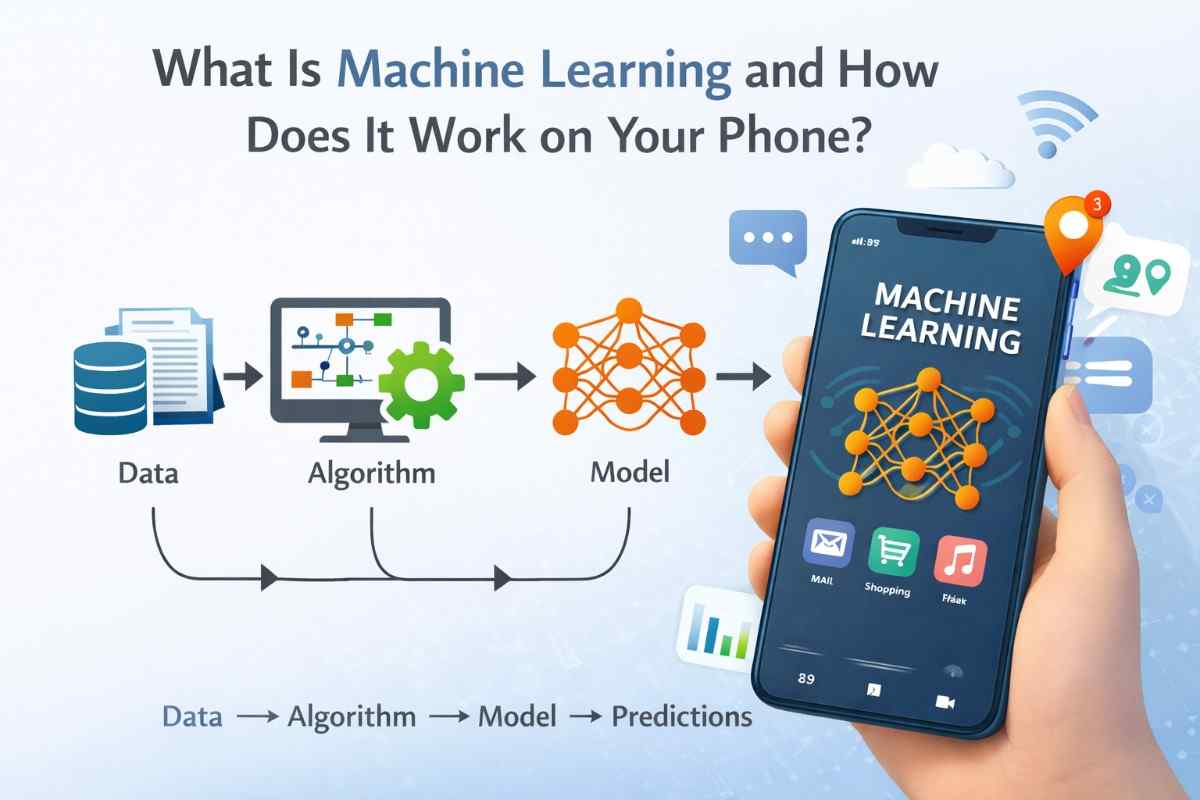
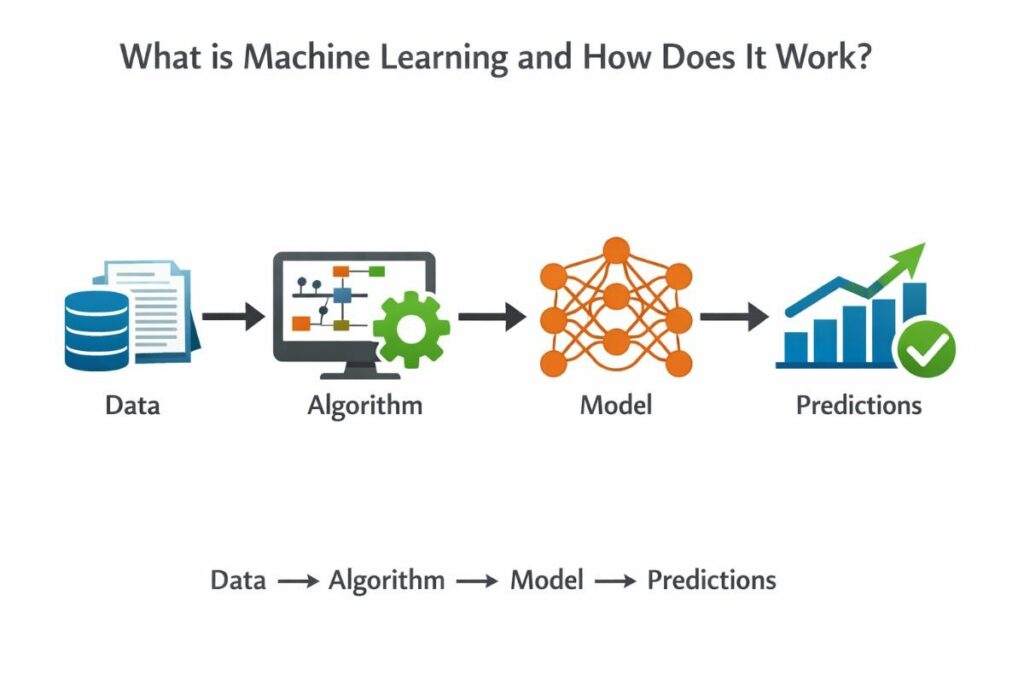
Understanding what is machine learning and how does it work becomes much easier when you break it down into 3 clear steps:
Step 1 — Training (Learning from Data) The machine learning model is fed large amounts of data — images, text, sounds, or numbers. At this stage, the algorithm analyses all this data and identifies patterns. For example, to build a face recognition system, you might feed the algorithm millions of labelled photos of faces.
Step 2 — Building the Model As the algorithm processes the data, it builds a “model” — essentially a mathematical representation of the patterns it has found. This model is what gets deployed into apps and devices. As Coursera explains, algorithms that have been trained sufficiently become “machine learning models” capable of performing specific tasks like sorting images or predicting outcomes.
Step 3 — Making Predictions (Inference) Once the model is trained and deployed, it can take new, unseen input data and make predictions or decisions based on what it has learned. When you point your camera at a face, the model instantly compares what it sees to what it learned and decides: is this the right person?
This cycle of training, building, and predicting is at the heart of every machine learning application — from your phone’s keyboard to Netflix recommendations.
3 Main Types of Machine Learning Explained
Not all machine learning works the same way. There are 3 main types, each suited to different problems:
1. Supervised Learning
In supervised learning, the algorithm is trained on labelled data — data that already has the correct answer attached. For example, thousands of images of cats labelled “cat” and dogs labelled “dog.” The algorithm learns the difference and can then correctly identify animals in new photos.
This is the most common type of machine learning and powers most of the features on your smartphone — including face unlock and spam filters.
2. Unsupervised Learning
Here, the algorithm is given unlabelled data and must find its own patterns without guidance. For example, your phone’s photo gallery might automatically group similar-looking faces together even without knowing who those people are — that is unsupervised learning at work.
3. Reinforcement Learning
This type works through trial and error. The algorithm receives a reward for correct actions and a penalty for wrong ones, gradually learning to make better decisions. It is the technology behind game-playing AI systems and is increasingly used to optimise how apps behave based on user feedback.
What Is Machine Learning and How Does It Work on Your Smartphone?
Your smartphone is one of the most powerful and personal machine learning platforms in the world. Modern phones contain dedicated AI chips (like Apple’s Neural Engine or Qualcomm’s AI Engine) specifically designed to run machine learning models efficiently on-device — without needing to send your data to the cloud.
This is important for two reasons: speed and privacy. On-device ML means your phone can make instant predictions without an internet connection, and your personal data stays on your device.
Here are the most significant ways machine learning powers your phone right now:
- Face ID and face unlock
- Autocorrect and predictive text
- Smart camera features (portrait mode, night mode, scene detection)
- Voice assistants (Siri, Google Assistant)
- App recommendations
- Battery optimisation
- Spam and fraud detection
Let’s explore the most important of these in detail.
Face Recognition: Machine Learning That Unlocks Your Phone
Every time you hold your phone up to your face and it unlocks in an instant, machine learning is working at remarkable speed.
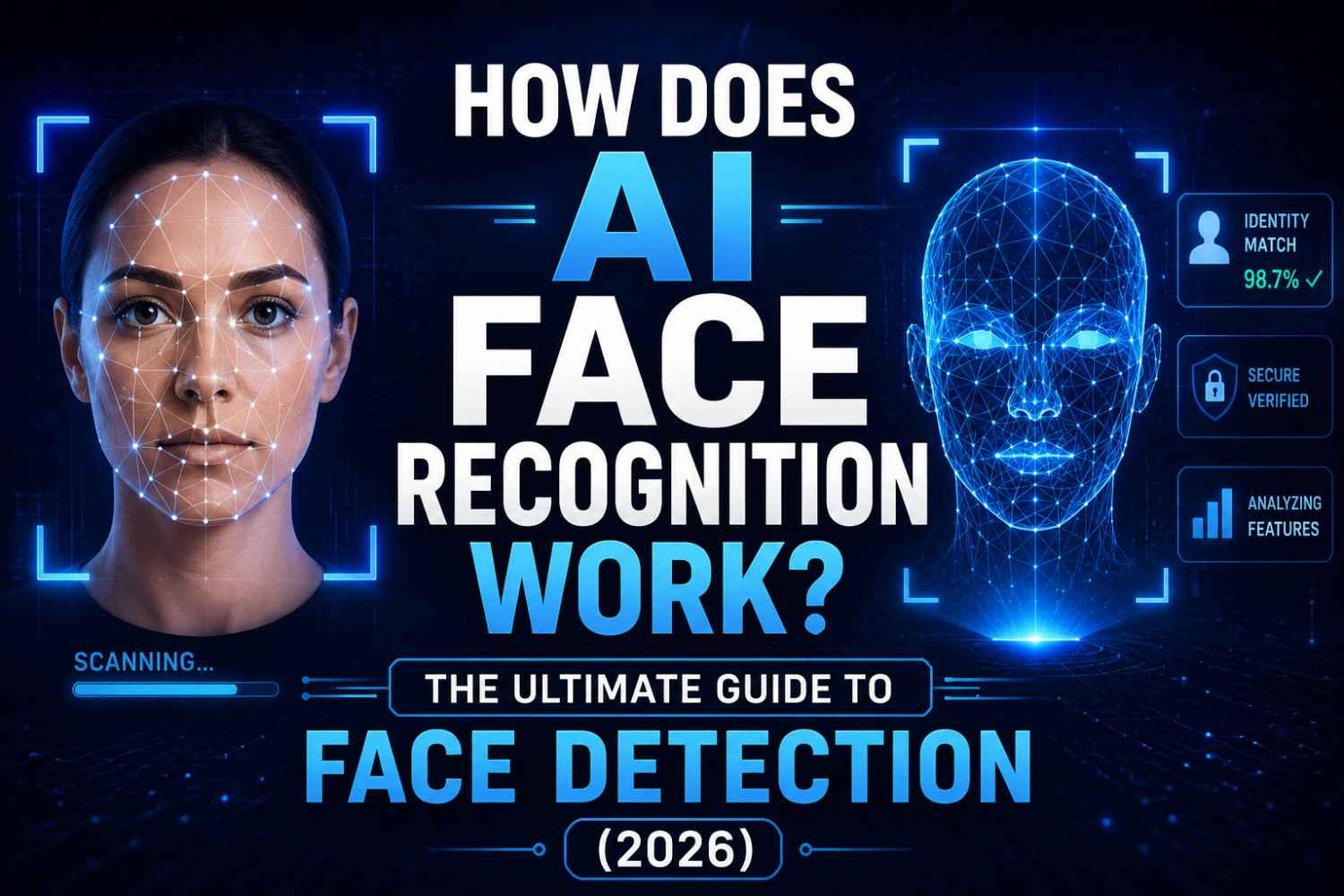
Face recognition is powered by deep learning and neural networks. Here is how the process works on your device:
- Image Capture — The front camera (and often an infrared sensor) captures your face
- Face Detection — An ML model identifies the face and separates it from the background
- Feature Extraction — The face is converted into a numerical “face embedding” — a unique set of measurements encoding the distances between your eyes, nose, cheekbones, and jaw
- Face Matching — The embedding is compared to the stored reference embedding created when you set up Face ID
- Decision — If the two embeddings are close enough, the phone unlocks
Apple started using deep learning for face detection in iOS 10, and their Face ID system has since become one of the most secure biometric systems available on any consumer device.
According to recent research, facial recognition technology under ideal conditions can achieve up to 99.97% accuracy — making it more reliable than many other forms of biometric security.
Autocorrect and Keyboard Suggestions Powered by Machine Learning
Autocorrect has come a long way from the embarrassing substitutions of early smartphones. Today, your phone’s keyboard is a sophisticated machine learning system.
Modern smartphone autocorrect uses neural language models — specifically a type of model that predicts the most likely word given the surrounding context. As one detailed breakdown explains, these systems combine ML with linguistic rules to:
- Predict the next word before you finish typing
- Correct misspellings by learning common typing patterns
- Adapt to your personal vocabulary, slang, and contacts over time
- Offer contextually relevant suggestions based on what you have typed before
One of the most privacy-friendly innovations here is federated learning — a technique where your phone’s keyboard model improves based on your personal typing habits, but your actual messages never leave your device. The phone only shares anonymous, aggregated pattern updates with the app’s servers.
This is how your phone seems to “learn” to stop correcting words you use often — it genuinely does.
How Machine Learning Makes Your Phone Camera Smarter
Your smartphone camera is arguably the area where machine learning has made the most dramatic visible impact. What once required a professional photographer and editing software can now be done automatically in real time.
Here is what machine learning does every time you open your camera app:
Scene Detection — ML models analyse the frame and identify what type of scene you are shooting — portrait, landscape, food, sunset, pet — and automatically adjust exposure, colour balance, and sharpness accordingly.
Portrait Mode and Bokeh — The camera uses machine learning to separate the subject from the background in real time, applying a professional-style blur that previously required expensive DSLR lenses.
Night Mode — ML models process multiple rapid exposures and intelligently combine them, reducing noise and brightening dark images without washing out colours.
Object and Face Tracking — As you move the camera, ML models continuously track moving subjects, keeping them sharp and in focus — essential for action shots and video calls.
AI Image Enhancement — Companies like Google and Huawei train their ML models on millions of images so the camera can recognise exactly what makes a photo look good and apply enhancements automatically.
As AIthority reports, Google’s custom machine learning models enable real-time image analysis and enhancement that were previously impossible on smartphones — making the computational photography experience feel almost magical.
Voice Assistants: Siri, Google Assistant, and Machine Learning
Asking your phone a question and getting a spoken answer back involves several layers of machine learning working together seamlessly.
When you say “Hey Siri” or “OK Google,” here is what happens:
- Wake Word Detection — A small, always-on ML model listens for your specific wake phrase
- Speech-to-Text — A neural network converts your spoken words into text with remarkable accuracy, even with accents and background noise
- Natural Language Understanding — Another ML model analyses the text to understand your intent — what you are actually asking for
- Response Generation — The assistant formulates a response and delivers it via text-to-speech
These systems improve constantly. Every time millions of users ask similar questions, the models learn from those patterns and become better at understanding diverse accents, new vocabulary, and increasingly complex requests.
Benefits and Risks of Machine Learning on Your Phone
Like any powerful technology, machine learning on smartphones brings both significant benefits and important risks worth understanding.
Benefits:
- Faster, more accurate face unlock and biometric security
- Smarter keyboards that adapt to your personal writing style
- Dramatically improved camera quality with no photography skills required
- Voice assistants that understand natural language
- Better battery life through intelligent power management
- Personalised app and content recommendations
Risks and Concerns:
- Privacy — Even on-device ML systems collect usage data that can be used to build detailed profiles
- Bias — ML models trained on limited or unrepresentative data can produce unfair or inaccurate results, particularly in face recognition across different ethnicities
- Security — Poorly designed ML systems can potentially be fooled by adversarial attacks
- Over-reliance — Autocorrect and AI suggestions can reduce human attention to spelling, grammar, and critical thinking
Being aware of these trade-offs helps you use your phone’s AI features more thoughtfully and make better choices about privacy settings.
Frequently Asked Questions
Q: What is machine learning and how does it work in simple terms? Machine learning is a type of AI where computers learn from examples rather than being given step-by-step rules. Feed the system enough data and it finds patterns — then uses those patterns to make decisions on new data.
Q: Is machine learning the same as AI? No. All machine learning is AI, but not all AI is machine learning. AI is the broader field; machine learning is one specific approach within it.
Q: Does my phone use machine learning without an internet connection? Yes. Modern smartphones have dedicated AI chips that run machine learning models entirely on-device, without needing to connect to the internet. This is faster and more private.
Q: What is the difference between machine learning and deep learning? Deep learning is a more advanced subset of machine learning that uses multi-layered artificial neural networks. Deep learning powers tasks like face recognition and voice assistants that simpler ML methods struggle with.
Q: Can machine learning on my phone be hacked? Like any technology, ML systems can be vulnerable. For example, some face recognition systems can be fooled by photos or 3D models of a face. Phone manufacturers constantly update their models to close such vulnerabilities.
Conclusion
What is machine learning and how does it work? Simply put: it is the technology that makes your smartphone genuinely smart.
From the moment you unlock your phone with your face to the instant your camera perfects a low-light photo, machine learning is working silently and at extraordinary speed. It learns from data, finds patterns, and applies those patterns to make intelligent decisions — all in milliseconds.
The 3 types — supervised, unsupervised, and reinforcement learning — each play a role in different features of your phone. And with dedicated AI chips making on-device ML faster and more private than ever, this technology will only grow more powerful with each new generation of smartphones.
Next time your keyboard predicts exactly the word you were about to type, or your camera instantly makes a dark photo look stunning — you will know exactly what is happening under the hood.