
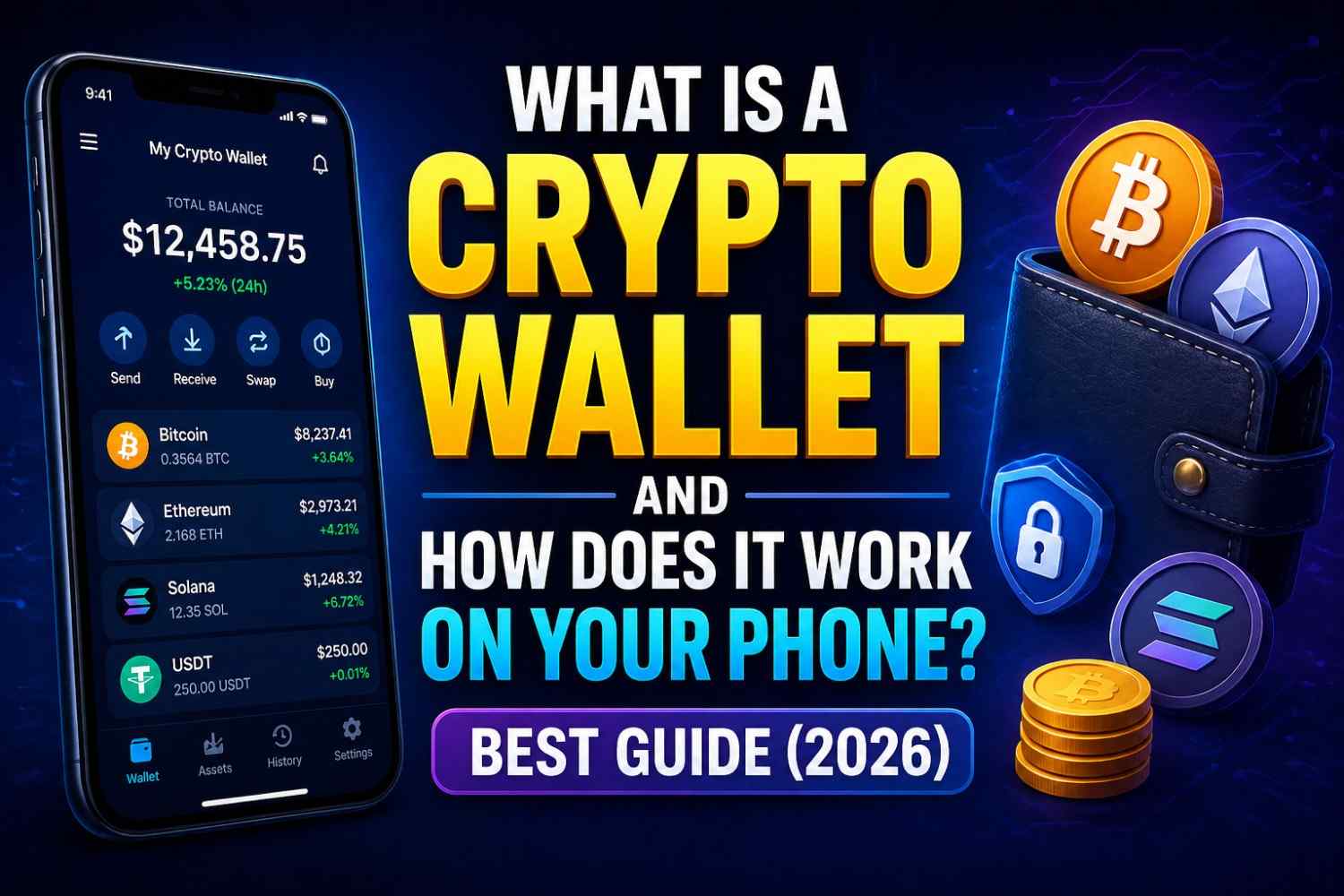
If you want to use any cryptocurrency — sending, receiving, or storing it — you need a crypto wallet. But what is a crypto wallet and how does it work is a question that trips up many people because the answer is counterintuitive: a crypto wallet does not actually store cryptocurrency. Understanding what is a crypto wallet and how does it work properly requires rethinking what “storing” crypto actually means.
This complete guide explains what is a crypto wallet and how does it work — covering the cryptographic keys at its core, the types available, how phone-based wallets function, and how to keep your crypto genuinely secure.
The Counterintuitive Truth: Wallets Don’t Store Crypto
The most important thing to understand about what is a crypto wallet and how does it work is that your cryptocurrency never actually lives inside your wallet. It lives on the blockchain.
Your Bitcoin, Ethereum, or other tokens exist as records on the blockchain — permanently recorded entries that say “address X owns Y coins.” Your wallet does not hold those coins. Your wallet holds the cryptographic keys that prove you own those coins and authorise you to move them.
Think of it this way: your wallet is like a keyring holding the keys to a safety deposit box. The box (the blockchain record) is in a vault (the blockchain). You don’t carry the vault with you — you carry the keys. What is a crypto wallet and how does it work in this analogy: it manages your keys so you can access and use your blockchain assets.
Public Keys and Private Keys: The Foundation of What Is a Crypto Wallet and How Does It Work
Understanding what is a crypto wallet and how does it work requires understanding two types of cryptographic keys:
Public Key (Your Blockchain Address)
Your public key is mathematically derived from your private key. It is shared openly — you give it to people who want to send you cryptocurrency, and it is visible on the public blockchain.
Your wallet address is a shortened, encoded version of your public key (typically 26–42 characters). For example, a Bitcoin address looks like: 1BvBMSEYstWetqTFn5Au4m4GFg7xJaNVN2
Private Key
Your private key is a randomly generated 256-bit number — essentially a password to your funds. It looks something like: 5Kb8kLf9zgWQnogidDA76MzPL6TsZZY36hWXMssSzNydYXYB9KF
What is a crypto wallet and how does it work as a security system? It uses your private key to:
- Generate cryptographic signatures that prove you authorise transactions
- Never expose the private key itself to the network — only the signature is broadcast
If anyone gets your private key, they can move all your funds. If you lose your private key, your funds are permanently inaccessible. There is no password reset. This is why private key management is the entire security story of what is a crypto wallet and how does it work.
Seed Phrases: The Master Key
Since private keys are long, random strings difficult to memorise or back up, most wallets use a seed phrase (also called a recovery phrase or mnemonic phrase) — a list of 12 or 24 common English words that can regenerate all your private keys.
Example: witch collapse practice feed shame open despair creek road again ice least
What is a crypto wallet and how does it work with a seed phrase? The wallet software uses your seed phrase as input to a deterministic algorithm (BIP-39 standard) that generates all your private keys in a reproducible way. The same seed phrase always generates the same private keys — meaning:
- You can restore your entire wallet on any new device using just the 12/24 words
- Losing the seed phrase means losing all access to your funds permanently
- Anyone who finds your seed phrase has complete access to all your crypto
Write your seed phrase on paper (never digitally), store it offline, and never share it with anyone under any circumstances.
Types of Crypto Wallets
Understanding what is a crypto wallet and how does it work across different types is essential for choosing the right solution:
Hot Wallets (Connected to the Internet)
Mobile Wallets (Phone Apps) Apps like MetaMask, Trust Wallet, and Coinbase Wallet run on your smartphone. What is a crypto wallet and how does it work as a phone app? The app stores your private keys in the phone’s secure storage (TEE/Secure Enclave) and handles transaction signing locally. Convenient for daily use but only as secure as your phone.
Desktop Wallets Software installed on your computer. Your private keys are encrypted and stored locally. More secure than exchange accounts but vulnerable if your computer is compromised.
Exchange Wallets (Custodial) Accounts on cryptocurrency exchanges (Coinbase, Binance, Kraken). Here, the exchange holds your private keys on your behalf — you don’t actually control the keys. Convenient but you are trusting the exchange. “Not your keys, not your coins” is the cautionary phrase used in the crypto community.
Cold Wallets (Offline — Not Connected to the Internet)
Hardware Wallets Physical devices (Ledger Nano X, Trezor Model T) that store your private keys offline. What is a crypto wallet and how does it work as hardware? Transactions are signed inside the secure chip of the hardware device — your private key never touches your internet-connected computer. The gold standard for securing significant amounts of crypto.
Paper Wallets Your public and private keys printed on paper and stored physically offline. Simple but fragile — damaged or lost paper = lost crypto.
How a Phone Crypto Wallet Works: Step by Step
Understanding what is a crypto wallet and how does it work on your phone in practical terms:
Receiving Crypto:
- Open your wallet app
- Find your wallet address (or QR code equivalent)
- Share the address with the sender
- The sender broadcasts a transaction to the blockchain
- The transaction appears in your wallet as “pending”
- After sufficient confirmations, it appears as received — your wallet app reads the blockchain and shows your updated balance
Sending Crypto:
- Enter recipient’s address and amount
- Set transaction fee
- Confirm the transaction details
- Your wallet uses your private key to generate a cryptographic signature
- The signed transaction is broadcast to the blockchain network
- Miners/validators confirm and record the transaction
- The blockchain record is updated — recipient receives funds
Hot Wallet vs Cold Wallet: Security Comparison
| Feature | Mobile/Hot Wallet | Hardware/Cold Wallet |
|---|---|---|
| Internet connected | Always | Never (when stored) |
| Private key location | Phone secure storage | Hardware chip |
| Convenience | High | Moderate |
| Security | Moderate | Very High |
| Cost | Free | £50–£200 |
| Best for | Daily use, small amounts | Long-term storage, large amounts |
| Recovery | Seed phrase | Seed phrase |
How to Keep Your Crypto Wallet Secure
What is a crypto wallet and how does it work as a security practice?
- Write down your seed phrase offline — never take a photo, screenshot, or store it digitally
- Use a hardware wallet for amounts above ~£500
- Enable biometric or PIN lock on your mobile wallet
- Never share your private key or seed phrase with anyone, for any reason
- Download wallets only from official sources — fake wallet apps are a major scam vector
- Use non-custodial wallets for significant holdings — where you control the private keys
According to Chainalysis’s 2024 Crypto Crime Report, the vast majority of cryptocurrency theft involves compromised hot wallets or exchange hacks — reinforcing the importance of cold storage for significant holdings.
For setting up a secure wallet, the Ledger Academy provides comprehensive tutorials on what is a crypto wallet and how does it work for hardware wallet users.
FAQs: What Is a Crypto Wallet and How Does It Work
Q1. What is a crypto wallet and how does it work in simple terms? A crypto wallet manages the private keys that prove you own cryptocurrency on a blockchain. It does not store coins — coins exist on the blockchain. The wallet stores your keys and uses them to sign transactions that move your coins.
Q2. What is a crypto wallet and how does it work if I lose my phone? If you have your seed phrase (12 or 24 recovery words), you can restore your wallet on any new device and immediately regain access to all your funds. Without the seed phrase, the funds are permanently inaccessible.
Q3. What is the safest type of crypto wallet? Hardware wallets (like Ledger or Trezor) are the safest option for significant holdings. They keep your private keys offline and sign transactions in a secure chip that never exposes the key to any internet-connected device.
Q4. What is a custodial vs non-custodial wallet? A custodial wallet (like an exchange account) means the provider holds your private keys — you trust them to secure your crypto. A non-custodial wallet means you hold your own private keys — you are solely responsible for security but no third party can access or freeze your funds.
Q5. Can a crypto wallet hold multiple currencies? Yes — most modern wallets (MetaMask, Trust Wallet, Ledger) are multi-currency wallets that support hundreds or thousands of different cryptocurrencies and tokens across multiple blockchains from a single seed phrase.
Q6. What happens if a wallet company closes down? If you use a non-custodial wallet, your funds are unaffected — you can restore your wallet on any compatible software using your seed phrase. If you use a custodial exchange wallet, your funds could be at risk — which is why the crypto community emphasises self-custody for significant holdings.
Conclusion
What is a crypto wallet and how does it work? It is a key management system — storing, protecting, and using the cryptographic private keys that prove ownership of cryptocurrency on a blockchain. The coins themselves live on the blockchain; the wallet gives you the means to control them.
Understanding what is a crypto wallet and how does it work — from seed phrases to cold storage to transaction signing — is the foundation of safe, confident cryptocurrency use. The technology is powerful but the responsibility is yours: control your keys, protect your seed phrase, and choose the right wallet type for your needs.