Introduction
Have you ever wondered how does AI image generation works? You type a few words — “a futuristic city at sunset” — and seconds later, a stunning, photorealistic image appears. It feels like magic. But behind the scenes, there is a fascinating chain of mathematics, data, and neural networks making it all happen.
AI image generation is one of the most exciting breakthroughs in modern technology. Tools like Midjourney, DALL·E 3, and Stable Diffusion are now used by artists, marketers, filmmakers, and everyday users around the world. Understanding how they work helps you use them better — and prepares you for the AI-powered future ahead.
What Is AI Image Generation?
AI image generation is the process of using artificial intelligence to create visual content from text prompts, existing images, or data inputs. Instead of a human artist drawing or designing, the AI model interprets your words and constructs an entirely new image, pixel by pixel.
This technology did not appear overnight. It is the result of decades of research in machine learning, computer vision, and deep learning. The most powerful systems today can generate images that are nearly indistinguishable from real photographs or professional artwork.
Also Read:-How Does AI Work? The Best Beginner’s Guide to Artificial Intelligence in 2026
The Core Technology: How Does AI Image Generation Work?
Understanding how does AI image generation work requires looking at two core technologies — Generative Adversarial Networks (GANs) and Diffusion Models.
Generative Adversarial Networks (GANs)
GANs were introduced by Ian Goodfellow in 2014. A GAN consists of two neural networks:
- The Generator — creates fake images from random noise
- The Discriminator — tries to detect whether an image is real or fake
These two networks compete against each other. The generator keeps improving to fool the discriminator, while the discriminator gets better at spotting fakes. Over millions of training cycles, the generator learns to create incredibly realistic images.
Early deepfake technology and AI portrait tools like This Person Does Not Exist used GANs.
Diffusion Models: The New Standard
Today’s leading tools — including Midjourney, DALL·E 3, and Stable Diffusion — use diffusion models. These work differently from GANs.
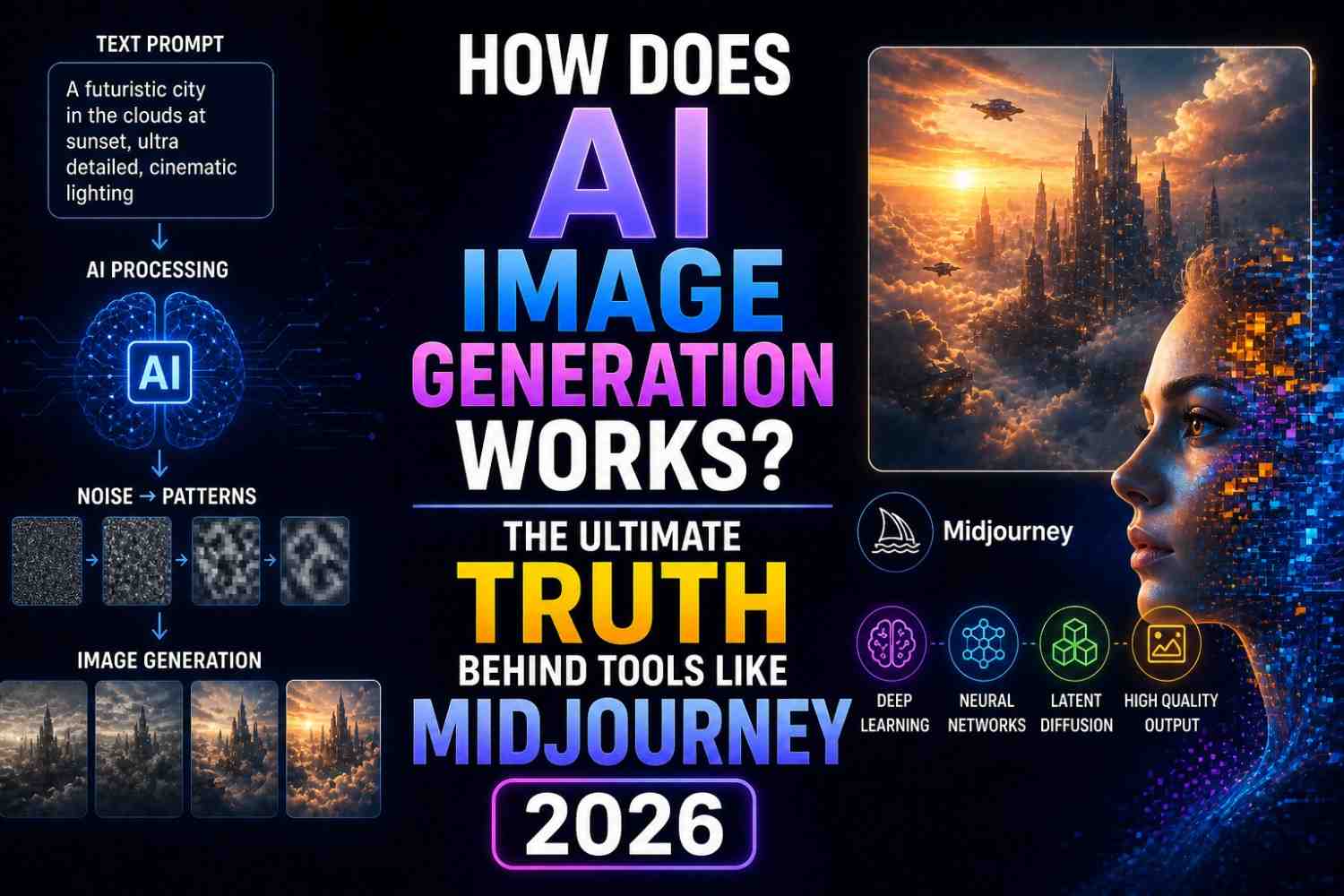
Here is how the process works step by step:
- Training Phase — The AI is trained on billions of images scraped from the internet. It learns patterns, styles, textures, and objects.
- Forward Diffusion — The training images are slowly corrupted with random noise until they become pure static.
- Reverse Diffusion — The model learns to reverse this process — starting from noise and gradually reconstructing a clear image.
- Text Conditioning (CLIP) — A system called CLIP (Contrastive Language–Image Pretraining) connects your text prompt to visual concepts. When you type “a dragon on a mountain,” CLIP ensures the AI understands both “dragon” and “mountain” visually.
Also Read:-How Does AI Work? The Best Beginner’s Guide to Artificial Intelligence in 2026
How Midjourney Specifically Works
Midjourney is one of the most popular AI image tools today. It operates through Discord and uses a proprietary diffusion model trained on a carefully curated dataset.
When you type a prompt like /imagine a watercolor painting of Paris in spring, here is what happens:
- Your text is tokenized and encoded using a language model
- The encoded prompt guides the reverse diffusion process
- The model runs multiple iterations, refining the image from noise
- You receive 4 image options in about 30–60 seconds
Midjourney also allows parameters like --ar 16:9 for aspect ratios, --style raw for realistic outputs, and --v 6 for the latest model version. These controls give users fine-tuned influence over the output.
DALL·E 3 vs. Stable Diffusion vs. Midjourney
| Feature | Midjourney | DALL·E 3 | Stable Diffusion |
|---|---|---|---|
| Accessibility | Discord-based | ChatGPT / API | Open source |
| Image Quality | Very high | High | Variable |
| Customization | Moderate | Low-moderate | Very high |
| Cost | Subscription | Credits | Free (local) |
| Best For | Art & design | Quick generation | Developers |
Each tool has strengths. Midjourney excels at artistic quality. DALL·E 3 is the most accessible. Stable Diffusion gives developers full control.
The Role of Training Data in AI Image Generation
One of the biggest controversies in how does AI image generation work relates to training data. These models were trained on billions of images — many of which were scraped from websites without explicit artist consent.
This has led to significant legal and ethical debates. Artists argue that their styles are being replicated without credit or compensation. AI companies argue the training process constitutes “fair use.”
As of 2026, multiple lawsuits are ongoing, and regulators in the EU and US are drafting AI content legislation. Users should be aware of these issues when using generated images for commercial purposes.
Real-World Applications of AI Image Generation
Understanding how does AI image generation work becomes even more exciting when you see its real-world uses:
- Marketing and advertising — brands generate product visuals and ad creatives
- Game development — concept art and texture creation
- Film and entertainment — storyboarding and visual effects
- Fashion — virtual clothing design and model imagery
- Education — illustrating textbooks and explainer content
- Architecture — rendering building designs from sketches
The technology is also expanding into video generation with tools like Sora by OpenAI, which applies similar diffusion principles to video frames.
Limitations of AI Image Generators
Despite their power, AI image tools still have notable weaknesses:
- Hands and fingers — AI historically struggles with realistic hands (improving but not perfect)
- Text inside images — generated text is often garbled
- Consistency — regenerating the exact same character or face is difficult
- Bias — models reflect biases in training data, often underrepresenting diverse populations
- Hallucinations — AI sometimes combines objects in illogical or physically impossible ways
Knowing these limitations helps set realistic expectations and use the tools more strategically.
The Future of AI Image Generation
The pace of improvement in AI image generation is extraordinary. In just three years, outputs have gone from obviously artificial to nearly indistinguishable from real photography.
Future developments to watch include:
- Real-time generation — instant image creation at full resolution
- 3D model generation — tools like Point-E already generate 3D objects
- Personalization — training models on your own style or face (LoRA models)
- Video and animation — seamless AI video generation
- Multimodal AI — systems that generate images, audio, and text together
FAQs: How Does AI Image Generation Works
Q1: What technology powers AI image generation? Most modern tools use diffusion models combined with CLIP-based text encoders. Earlier tools used GANs.
Q2: Is AI-generated art copyrightable? Currently, in the US, AI-generated images without significant human authorship are not copyrightable. Laws are evolving.
Q3: How long does it take AI to generate an image? Most tools take between 10 seconds and 2 minutes depending on resolution and server load.
Q4: Can AI copy an artist’s style? AI can replicate stylistic patterns it learned during training. This is legally and ethically contested.
Q5: What is the best AI image generator in 2026? Midjourney v6 and DALL·E 3 are widely considered the best for quality and ease of use.
Q6: Is AI image generation free? Stable Diffusion is free and open-source. Midjourney and DALL·E offer limited free tiers with paid subscriptions.
Conclusion
Understanding how does AI image generation work puts you ahead in the creative and digital economy. Whether you are a designer, marketer, developer, or curious learner, these tools are reshaping visual content forever. Start experimenting today — and explore tools like Midjourney or DALL·E to see the technology in action yourself.