They sold for millions of dollars. Artists, musicians, and brands rushed to create them. Then the market crashed. But beneath the hype and the volatility, how does NFT work as a technology is genuinely interesting and potentially transformative — regardless of what any particular NFT sells for on any particular day.
Understanding how does NFT work requires separating the technology from the speculation. The technology answers a genuinely hard problem: how do you establish verifiable, transferable ownership of a digital asset when digital files can be copied infinitely? How does NFT work is the answer to that question — and the answer involves blockchain, smart contracts, and cryptographic proof of ownership.
What Does NFT Stand For and What Does It Mean?
NFT stands for Non-Fungible Token.
Understanding how does NFT work starts with understanding “non-fungible”:
Fungible means interchangeable. One Bitcoin is identical to any other Bitcoin — they are fungible. A £10 note is fungible with any other £10 note.
Non-fungible means unique and not interchangeable. The original Mona Lisa is non-fungible — there is only one, and it cannot be swapped for an identical replacement. A specific house at a specific address is non-fungible.
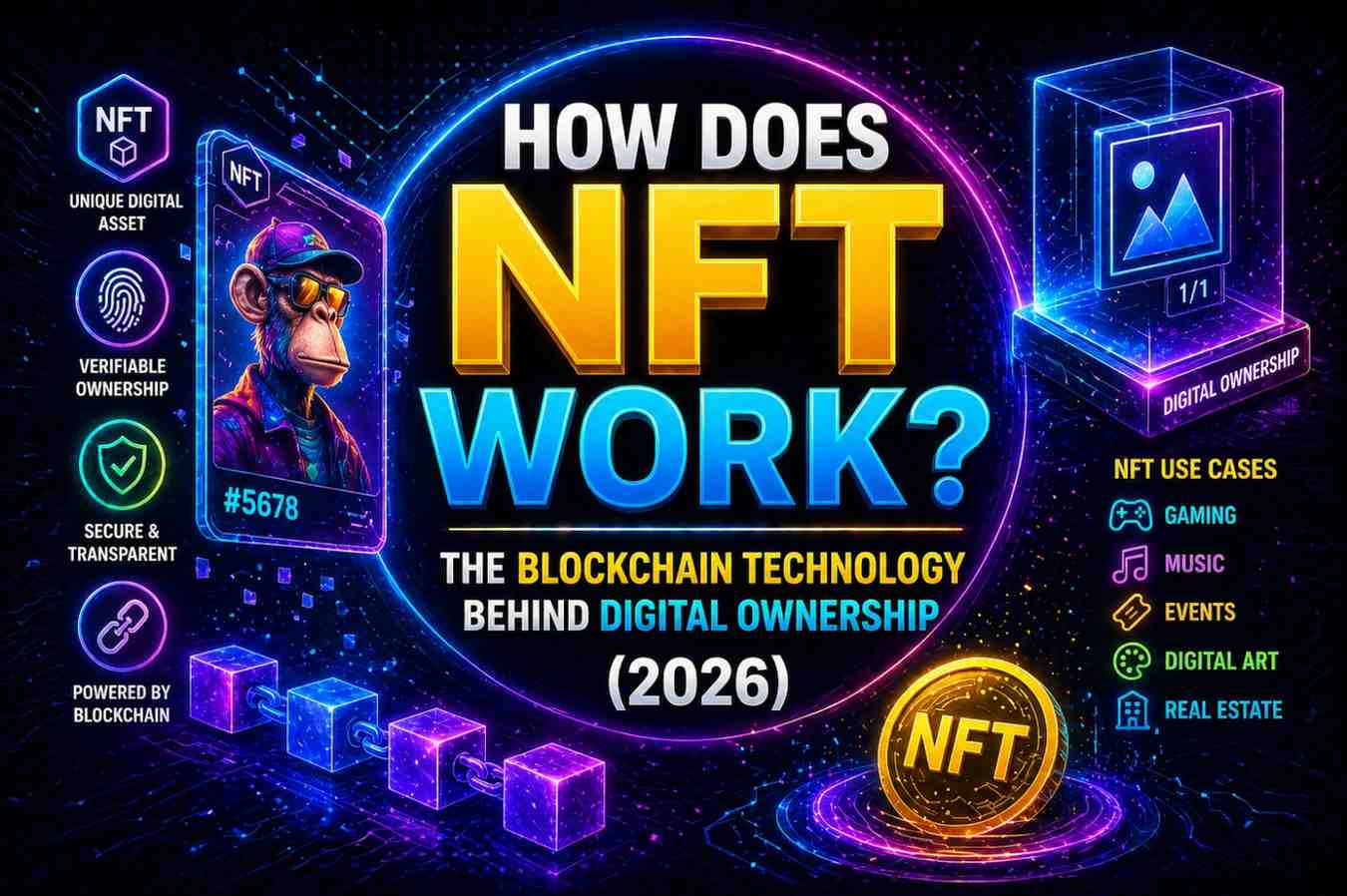
An NFT is a unique digital token on a blockchain — each one is distinct, identified by a unique token ID, and its ownership is permanently recorded on the blockchain. This is the core of how does NFT work: it creates digital uniqueness and verifiable ownership.
How Does NFT Work: The Technical Foundation
How does NFT work technically relies on blockchain smart contracts — specifically the ERC-721 token standard on Ethereum (and similar standards on other blockchains).
ERC-721 is a smart contract interface that defines:
- A unique token ID for each NFT (no two tokens can have the same ID within a contract)
- An ownership record mapping each token ID to a blockchain address
- Functions for transferring ownership from one address to another
- Functions for approving others to transfer on your behalf
When an NFT is created (“minted”), the smart contract creates a new unique token ID and assigns it to the creator’s wallet address. This is immutably recorded on the blockchain.
How does NFT work for ownership transfer? When you buy an NFT, the smart contract’s ownership mapping is updated — your address replaces the previous owner’s for that specific token ID. This transfer is permanent and publicly verifiable by anyone.
NFT Metadata: What Does the NFT Actually Point To?
Here is a crucial and often misunderstood aspect of how does NFT work: the NFT itself (the on-chain token) typically does not contain the actual digital artwork or file. It contains metadata — a reference that points to the asset.
The metadata usually includes:
- Name: “CryptoPunk #7804”
- Description: A text description
- Image: A URL pointing to the image file
- Attributes: Traits and properties (e.g., “hat type: fedora”)
Where is the actual image stored?
This is where how does NFT work has an important nuance:
Centralised storage (risky): If the metadata URL points to a standard web server, the image exists only as long as that server runs. The NFT could become a “broken link” if the hosting service shuts down.
IPFS (InterPlanetary File System): Most NFT projects use IPFS — a decentralised content-addressed storage network. Files stored on IPFS are identified by their content hash rather than a location URL. If the content exists anywhere on IPFS, it is accessible. This is more resilient than centralised servers.
On-chain storage: Some NFTs (like Autoglyphs and fully on-chain art) store the actual artwork data directly in the smart contract — the most permanent but most expensive approach.
How Does NFT Work: The Minting Process Step by Step
Minting is the process of creating a new NFT. How does NFT work during minting:
- Prepare the asset: The creator has a digital file (image, video, music, 3D model)
- Upload to storage: The file is uploaded to IPFS or another storage solution, generating a content hash URL
- Create metadata: A JSON file is created containing name, description, image URL, and traits; this metadata file is also uploaded to IPFS
- Deploy or use contract: The creator deploys or connects to an ERC-721 (or ERC-1155 for multi-edition) smart contract
- Call the mint function: A transaction calls the contract’s mint function with the metadata URL
- Gas fees paid: The creator pays ETH gas fees to execute the transaction
- Token created: The smart contract creates a new token ID and assigns ownership to the creator’s address
- Permanent record: The minting transaction is permanently recorded on the Ethereum blockchain — the NFT now exists
NFT Royalties: How Does NFT Work for Creators Long-Term?
One of the most compelling aspects of how does NFT work is programmable royalties.
Smart contracts can specify that a percentage of every secondary sale (resale) is automatically sent to the original creator. If an artist sets a 10% royalty:
- The NFT sells for 1 ETH → artist receives 0.1 ETH automatically
- The NFT resells for 5 ETH → artist receives 0.5 ETH automatically
- Every subsequent resale → artist receives their percentage forever
How does NFT work for royalty enforcement is more complex in practice — this depends on the marketplace enforcing the royalty. Some marketplaces (particularly newer ones focused on traders) have reduced or eliminated royalty enforcement, creating significant controversy in the NFT community.
Real Use Cases: How Does NFT Work Beyond Digital Art
How does NFT work extends well beyond speculative digital art:
Music: Musicians release albums or songs as NFTs — providing direct revenue without streaming platforms, plus ongoing royalties on secondary sales. Artists like Kings of Leon and Grimes have used NFTs.
Gaming: In-game items (weapons, skins, characters) as NFTs that players truly own and can sell outside the game. This enables genuine player-owned economies.
Ticketing: Event tickets as NFTs prevent fraud (no fake tickets), enable royalties on resale (preventing scalper profits going entirely to scalpers), and provide persistent digital souvenirs.
Credentials and certificates: Educational certificates, professional certifications, and membership passes issued as NFTs — verifiable, unforgeable, and portable.
Real Estate: Some real-world property transfers have been recorded on blockchain using NFTs as the ownership token, though legal frameworks are still developing.
Domain Names: ENS (Ethereum Name Service) domains are NFTs — human-readable names (alice.eth) that map to Ethereum wallet addresses.
The NFT Market: What Happened?
Understanding how does NFT work is separate from understanding NFT market dynamics. The 2021–2022 NFT boom saw extraordinary prices — the digital artist Beeple’s “Everydays: The First 5000 Days” sold for $69 million. Subsequently, the market collapsed 90%+ from peak values.
How does NFT work as a market versus as a technology?
The technology itself — verifiable digital ownership via blockchain — remains functional and is finding sustainable use cases beyond speculative art. The price collapse reflected speculative excess rather than a failure of the underlying technology.
According to DappRadar’s NFT Market Report, NFT trading volume stabilised significantly after the 2022 correction, with gaming and utility NFTs showing more sustainable growth patterns than pure collectible art NFTs.
For the original ERC-721 standard that defines how does NFT work at the technical level, EIP-721 on Ethereum Improvement Proposals is the authoritative specification.
FAQs: How Does NFT Work
Q1. How does NFT work to prove ownership? An NFT is a unique token recorded on a blockchain smart contract. The contract maintains a public mapping of token IDs to owner addresses. Ownership is provable to anyone by checking this on-chain record — it cannot be faked, altered, or disputed.
Q2. If anyone can screenshot an NFT image, what’s the point? The screenshot is a copy of the file — the NFT is the verifiable ownership record. This is similar to anyone being able to print a photo of the Mona Lisa, but only one person owns the actual painting. The value is in the authenticated original ownership, not the file itself.
Q3. How does NFT work on blockchains other than Ethereum? NFT standards similar to ERC-721 exist on most major blockchains — Solana (Metaplex), Polygon (lower fees than Ethereum mainnet), Flow (NBA TopShot), Tezos (Objkt), and others. Each blockchain has its own smart contract language and token standards, but the fundamental concept of unique, blockchain-recorded ownership tokens is the same.
Q4. What is an NFT smart contract and why does it matter? The smart contract is the code that creates and manages NFTs — defining their rules, ownership transfers, royalties, and metadata. The contract is deployed permanently on the blockchain. The quality and security of the smart contract directly affects the NFT’s functionality and how does NFT work in practice.
Q5. How much does it cost to mint an NFT? On Ethereum mainnet, minting costs gas fees — typically $5–$100+ depending on network congestion. On Layer 2 solutions (Polygon, Base) or other chains (Solana, Tezos), costs are much lower — often fractions of a cent to a few dollars. Some platforms offer “lazy minting” — the NFT is only truly minted on-chain when first purchased.
Q6. Are NFTs environmentally friendly? Since Ethereum’s Merge (September 2022), Ethereum-based NFTs use Proof of Stake — consuming 99.95% less energy than before. NFTs on Ethereum are now much more environmentally defensible than they were during the 2021 PoW-era boom.
Conclusion
How does NFT work? An NFT is a unique token created by a smart contract on a blockchain, with a permanent ownership record that cannot be altered or faked. Minting assigns ownership to the creator; buying transfers that ownership record; smart contract royalties ensure creators can earn from secondary sales. The actual digital asset is typically stored on IPFS or on-chain, referenced by the token’s metadata.
Understanding how does NFT work separates the enduring technology from the speculative market cycle. Verifiable digital ownership is a genuinely new capability — with use cases in art, music, gaming, ticketing, credentials, and finance that extend well beyond the collectibles boom and crash.