Imagine a contract that enforces itself automatically — no lawyers, no courts, no banks needed to execute it. You agree to terms, the conditions are met, and the outcome happens instantly and irrevocably. This is exactly what a smart contract does. But what is a smart contract and how does it work in technical reality — and what makes it so potentially transformative?
What is a smart contract and how does it work is one of the most important questions in blockchain technology — because smart contracts are what transformed blockchain from a simple transaction ledger into a programmable platform capable of executing complex agreements, running decentralised applications, and automating financial systems without any human intermediary.
The Classic Explanation: A Vending Machine for Contracts
The simplest analogy for understanding what is a smart contract and how does it work is a vending machine.
A vending machine:
- Has specific rules programmed in (insert £1.50, press B3 → dispense item B3)
- Executes automatically when conditions are met (coin inserted, button pressed)
- Requires no human cashier or manager to process the transaction
- Cannot deviate from its programming — it does exactly what it was programmed to do
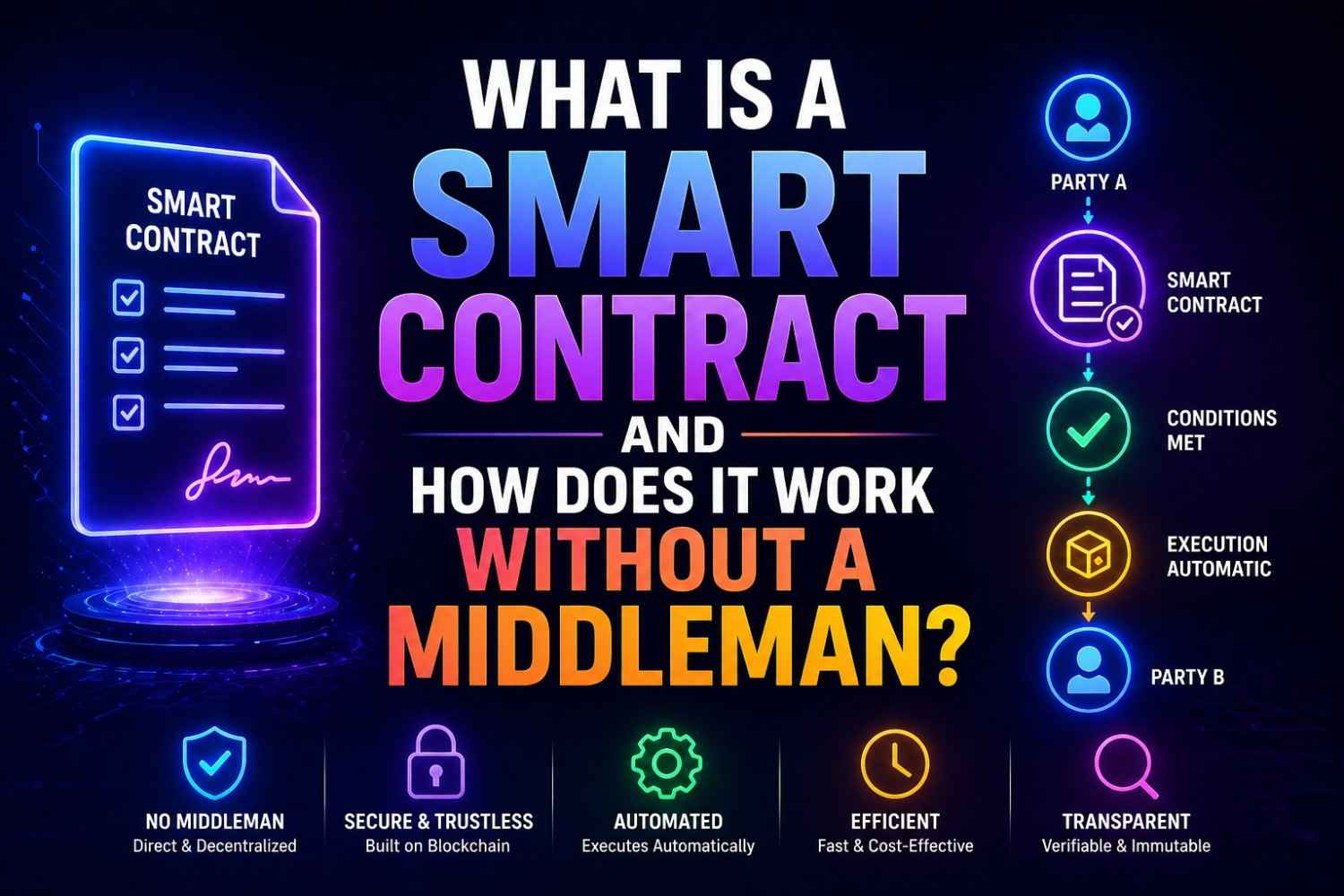
What is a smart contract and how does it work? It is a vending machine for any kind of agreement — programmed rules stored on a blockchain that execute automatically when specified conditions are met, without any third party needed to enforce or process the outcome.
What Is a Smart Contract and How Does It Work: Technical Definition
A smart contract is a self-executing program stored on a blockchain whose terms are written directly in code. Once deployed to the blockchain, the code:
- Cannot be altered by anyone (including the creator)
- Executes automatically when its programmed conditions are met
- Produces outcomes that are recorded permanently on the blockchain
- Operates transparently — the code is readable by anyone
Understanding what is a smart contract and how does it work at the code level: smart contracts are programs written in languages like Solidity (for Ethereum) that define:
- State variables — data stored on the blockchain (balances, ownership records, etc.)
- Functions — actions that can be triggered (transfer funds, update records, etc.)
- Conditions (if/then logic) — when specific functions should execute
What Is a Smart Contract and How Does It Work: A Real Example
Let’s make what is a smart contract and how does it work concrete with a property rental example:
Smart Contract: Monthly Rent Agreement
- If: Tenant pays 0.5 ETH to contract address by 1st of month
- Then: Digital key code is released to tenant
- If: Payment not received by 3rd of month
- Then: Key code is changed; deposit portion transferred to landlord
- If: All 12 months completed
- Then: Deposit automatically returned to tenant
This entire agreement is deployed to the Ethereum blockchain. No landlord needs to manually receive payment and send keys. No tenant needs to trust the landlord to return the deposit. The contract code executes exactly as written — automatically, publicly, and irrevocably.
This is what is a smart contract and how does it work in everyday terms — replacing trust-based human processes with mathematically enforced code.
The Ethereum Virtual Machine: Where Smart Contracts Run
Understanding what is a smart contract and how does it work technically requires understanding the Ethereum Virtual Machine (EVM).
The EVM is a decentralised computing environment — it runs on every Ethereum node simultaneously. When a smart contract function is called:
- The calling transaction is broadcast to the Ethereum network
- Every node’s EVM executes the same function with the same inputs
- All nodes reach the same result through deterministic execution
- The result (state changes, fund transfers, events) is recorded on the blockchain
The EVM ensures what is a smart contract and how does it work identically on every node — there is no ambiguity or variation in how the contract interprets its instructions.
Gas: The Cost of Smart Contract Execution
When a smart contract executes, it consumes computational resources on every node in the network. How does this get compensated? Through gas — Ethereum’s unit of computational cost.
Every operation in a smart contract (addition, storage write, function call) has a defined gas cost. Before executing, the caller specifies a gas limit and pays a gas fee in ETH. If the function runs out of gas mid-execution, it reverts with no state changes (but the gas is still consumed).
Gas is how what is a smart contract and how does it work economically — preventing infinite loops, spam, and denial-of-service attacks by making computation costly.
Real-World Applications: What Is a Smart Contract and How Does It Work in Practice
DeFi (Decentralised Finance): Lending protocols like Aave and Compound use smart contracts to:
- Accept deposited crypto as collateral
- Automatically issue loans based on collateral ratios
- Automatically liquidate undercollateralised positions
- Distribute interest to depositors in real time No bank accounts, credit checks, or loan officers required.
NFTs (Non-Fungible Tokens): Smart contracts define the rules of NFT ownership — who currently owns the token, how royalties are distributed on secondary sales, and what metadata the token references.
DAOs (Decentralised Autonomous Organisations): Organisations governed entirely by smart contracts — members vote on proposals using governance tokens, and the contract automatically implements approved proposals without requiring any CEO or board to execute decisions.
Supply Chain: Smart contracts automatically release payment to suppliers when blockchain-verified proof of delivery is received.
Insurance: Parametric insurance smart contracts automatically pay out when specific conditions are met — for example, if a flight is delayed by more than 2 hours (verified from flight data oracles), the contract automatically compensates the policyholder.
Limitations and Risks of Smart Contracts
What is a smart contract and how does it work in terms of its risks? The code is immutable — bugs cannot be patched after deployment. Several major hacks have exploited smart contract vulnerabilities:
- The DAO hack (2016): A reentrancy vulnerability in a smart contract was exploited to drain $60 million worth of Ether
- Parity wallet bug (2017): A vulnerability locked ~$300 million in ETH permanently
- Various DeFi protocol exploits (ongoing): Flash loan attacks, oracle manipulation, and logic errors have cost billions
The immutability of smart contracts — the source of their trustlessness — is also their greatest risk. What is a smart contract and how does it work as a risk factor: once deployed, bad code cannot be fixed without extraordinary measures (hard forks, which require network-wide consensus).
According to Ethereum Foundation’s documentation, smart contracts enable applications that are open, transparent, permissionless, and not controlled by any central entity — a paradigm shift in how agreements are made and enforced globally.
For learning to write smart contracts, Solidity’s official documentation provides the complete programming language reference for Ethereum smart contract development.
FAQs: What Is a Smart Contract and How Does It Work
Q1. What is a smart contract and how does it work in simple terms? A smart contract is a self-executing program on a blockchain. It automatically performs specific actions (transfer funds, update records) when defined conditions are met — without any human or institution needed to enforce or process the outcome.
Q2. What is a smart contract and how does it work without a middleman? The contract code replaces the middleman. Instead of trusting a bank to process a payment or a lawyer to enforce a contract, you trust the code — which executes exactly as written with no ability to deviate, regardless of what either party wants after the fact.
Q3. Can a smart contract be changed after deployment? No — once deployed to the blockchain, a smart contract’s code is immutable. It cannot be changed or deleted. Some smart contracts include upgrade mechanisms (proxy patterns) but these are optional design choices, not default behaviour.
Q4. What programming language are smart contracts written in? Solidity is the most common language for Ethereum smart contracts — a JavaScript/C++ influenced language designed specifically for EVM-compatible blockchains. Other options include Vyper (Python-influenced), Rust (for Solana), and several others across different blockchain platforms.
Q5. Are smart contracts legally binding? This varies by jurisdiction. Some countries (including the UK and several US states) have passed legislation recognising smart contracts as legally enforceable. The legal status continues to evolve as regulators grapple with the novel nature of self-executing blockchain code.
Q6. What is a smart contract oracle and why is it needed? Smart contracts cannot access data outside the blockchain on their own. An oracle is a trusted data feed that brings real-world information (price data, weather, sports results) onto the blockchain for smart contracts to use. Chainlink is the most widely used oracle network — critical infrastructure for what is a smart contract and how does it work in real-world applications.
Conclusion
What is a smart contract and how does it work? It is a self-executing program deployed permanently on a blockchain, whose code automatically enforces agreement terms when programmed conditions are met — without lawyers, banks, or any human intermediary.
Understanding what is a smart contract and how does it work reveals why Ethereum’s invention of programmable blockchain was such a step change from Bitcoin — transforming the blockchain from a simple ledger into a platform capable of running any application with the security, transparency, and trustlessness of blockchain.
Explore the ecosystem: Our guide on how Ethereum works explains the platform that made smart contracts mainstream, and our NFT guide shows one of the most visible applications of this technology.