Introduction
What is natural language processing? If you have ever spoken to Siri, received a spam filter that caught a suspicious email, or used Google Translate, you have already experienced natural language processing (NLP) in action. It is the branch of artificial intelligence that teaches computers to understand, interpret, and generate human language.
Language is messy, nuanced, and full of context. Sarcasm, idioms, regional dialects, and ambiguous phrasing make it extraordinarily difficult for machines to process. NLP is the technology that bridges the gap between human communication and machine understanding — and in 2026, it is at the heart of nearly every AI system we interact with daily.
What Is Natural Language Processing? A Clear Definition
Natural language processing (NLP) is a subfield of artificial intelligence and computational linguistics that focuses on enabling computers to process and analyze human language — whether written or spoken.
The goal of NLP is not just to recognize words, but to understand meaning, intent, sentiment, and context. This requires combining linguistics, statistics, and deep learning in sophisticated ways.
A Brief History of NLP
- 1950s — Alan Turing proposed the Turing Test, asking whether machines could converse like humans
- 1960s–1980s — Rule-based systems used handcrafted linguistic rules
- 1990s — Statistical NLP emerged, using probabilities rather than hard rules
- 2013 — Word2Vec introduced word embeddings, teaching AI relationships between words
- 2017 — Transformer architecture (Google) revolutionized NLP
- 2018–2026 — BERT, GPT, and large language models dominate NLP research and applications
Read Also:How Does a Blockchain Transaction Work? Step-by-Step for Beginners (2026)
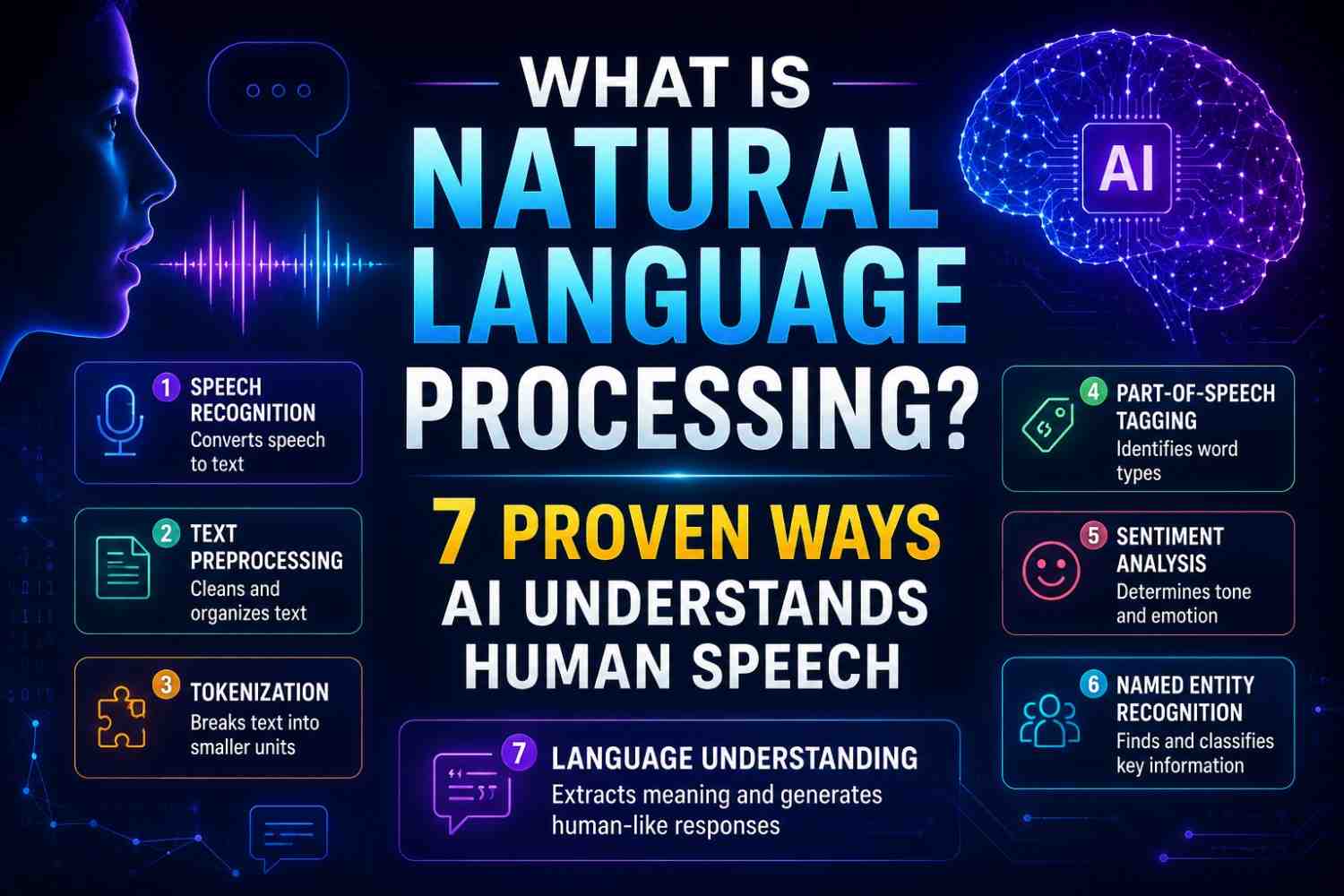
The 7 Core Tasks in Natural Language Processing
1. Tokenization
Tokenization breaks text into individual words or subwords called tokens. “I love pizza” becomes [“I”, “love”, “pizza”]. This is the foundation of all NLP tasks.
2. Part-of-Speech Tagging (POS)
POS tagging labels each word with its grammatical role — noun, verb, adjective, etc. This helps the AI understand the structure of a sentence.
3. Named Entity Recognition (NER)
NER identifies proper nouns — names of people, places, organizations, and dates. In “Apple launched a product in California,” NER recognizes “Apple” as a company and “California” as a location.
4. Sentiment Analysis
Sentiment analysis determines whether text is positive, negative, or neutral. Businesses use this to monitor brand reputation and analyze customer reviews automatically.
5. Machine Translation
Translation systems like Google Translate use NLP to understand the meaning of a source sentence and reconstruct it in another language naturally.
6. Text Summarization
NLP systems can read a 10-page document and generate a 3-sentence summary, preserving the key points.
7. Question Answering
Systems like ChatGPT and Google’s Gemini use NLP to understand questions and generate accurate, contextual answers.
Read Also:How does AI image generation works? The Ultimate Truth Behind Tools Like Midjourney 2026
How Does Natural Language Processing Actually Work?
Modern NLP is powered by transformer models and large language models (LLMs). Here is the simplified process:
- Text is converted to numerical vectors — Words are represented as numbers that capture meaning and relationships
- Attention mechanisms — The transformer model pays “attention” to different parts of the sentence to understand context
- Prediction and generation — The model predicts the most likely next word, answer, or output based on learned patterns
- Fine-tuning — Pretrained models are further trained on specific tasks like customer service or medical diagnosis
The key insight of the transformer architecture is the attention mechanism — instead of processing words one at a time, it processes the entire sentence simultaneously, understanding how every word relates to every other word.
Real-World Applications of NLP in 2026
Understanding what is natural language processing is most rewarding when you see it in action:
- Virtual assistants — Alexa, Siri, Google Assistant all rely on NLP
- Spam filters — Email providers use NLP to detect unwanted content
- Chatbots — Customer service bots understand and respond to queries
- Search engines — Google uses NLP to interpret search queries
- Healthcare — NLP extracts patient information from medical records
- Finance — Trading algorithms analyze news sentiment to predict markets
- Legal — Contracts are reviewed and summarized automatically
- Education — AI tutors adapt explanations based on student responses
NLP Challenges: Why Human Language Is Hard for Machines
Despite incredible advances, NLP still faces real challenges:
| Challenge | Example |
|---|---|
| Ambiguity | “I saw the man with the telescope” — who had the telescope? |
| Sarcasm | “Oh great, another Monday” — AI may read this as positive |
| Context dependency | “It” can refer to many things depending on earlier conversation |
| Multilingual complexity | Low-resource languages have limited training data |
| Cultural references | Idioms like “kick the bucket” confuse literal-minded models |
The Difference Between NLP, NLU, and NLG
These three terms are often confused:
- NLP (Natural Language Processing) — the broad umbrella term
- NLU (Natural Language Understanding) — the AI understanding the meaning of input language
- NLG (Natural Language Generation) — the AI generating human-readable output
When you ask ChatGPT a question (NLU processes it) and it writes you a detailed answer (NLG produces it), both are subsets of NLP.
FAQs: What Is Natural Language Processing
Q1: What is natural language processing in simple terms? It is the ability of computers to read, understand, and respond to human language in a meaningful way.
Q2: What is an example of NLP in everyday life? Google Search, email spam filters, autocorrect on your phone, and voice assistants all use NLP.
Q3: What programming languages are used for NLP? Python is the most popular, with libraries like spaCy, NLTK, and Hugging Face Transformers.
Q4: Is NLP the same as AI? NLP is a subset of AI. AI is the broader field; NLP specifically focuses on language.
Q5: What is the most advanced NLP model in 2026? Models like GPT-4o, Gemini Ultra, and Claude 3 Opus are among the most capable NLP systems available.
Q6: How is NLP used in healthcare? NLP extracts information from clinical notes, assists in diagnosis, and powers medical chatbots.
Conclusion
So, what is natural language processing? It is the remarkable technology that lets machines communicate with us in our own language. From the spam filter protecting your inbox to the chatbot answering your support ticket, NLP is everywhere. As LLMs grow more powerful in 2026, the line between human and machine communication continues to blur. Explore NLP tools firsthand at Hugging Face — the leading open-source NLP platform.