Introduction
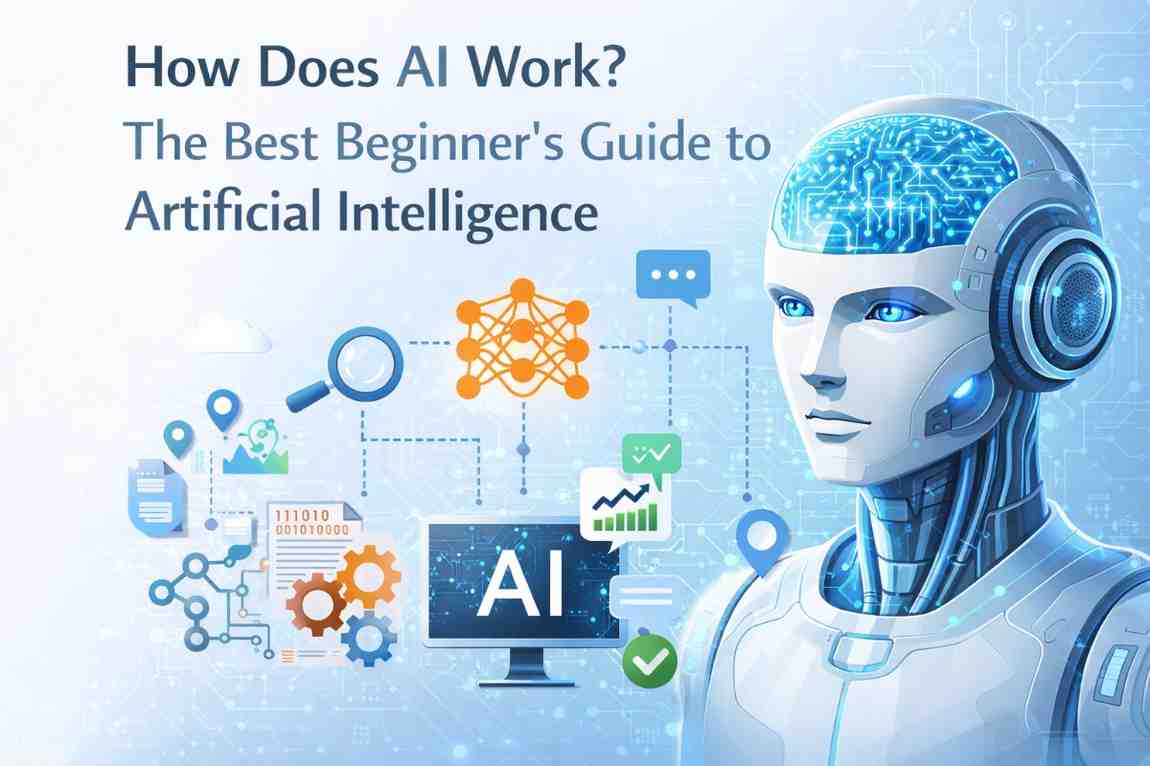
Artificial intelligence powers your smartphone, recommends your Netflix shows, and might have even helped write your last email. But how does AI work behind the scenes?
Unlike traditional software that follows strict rules, AI systems learn from experience—much like humans do. They recognize patterns, make predictions, and improve over time without being explicitly programmed for every scenario.
This beginner-friendly guide demystifies AI technology. You’ll understand the core concepts, see how machines actually learn, and discover why AI has become so powerful in 2025—all explained in plain English without complex mathematics.
What Is Artificial Intelligence? The Foundation
Before exploring how does AI work, let’s define what AI actually is.
Simple Definition:
Artificial Intelligence is the ability of machines to perform tasks that typically require human intelligence—like recognizing faces, understanding speech, making decisions, or translating languages.
Key Characteristics:
AI systems can:
- Learn from data rather than following fixed rules
- Adapt to new situations
- Recognize complex patterns
- Make predictions based on experience
- Improve performance over time
AI vs. Traditional Programming:
Traditional Software:
IF temperature > 75°F THEN turn on ACYou write exact instructions for every scenario.
AI Systems:
Learn from 10,000 examples of when people felt hot
Predict when to turn on AC based on patterns
The system figures out the rules by learning from data.
The Goal:
AI aims to create machines that can perceive their environment, understand it, learn from it, and take intelligent actions—approaching (but not yet matching) human-level reasoning.
The Three Levels of AI
Understanding how does AI work requires knowing the different types.
Narrow AI (Weak AI) – What We Have Now
Definition: AI designed for specific tasks.
Examples:
- Siri and Alexa (voice assistants)
- Netflix recommendations
- Google search
- Spam filters
- Self-driving car systems
- Chess-playing programs
- Image recognition
Capabilities: These systems excel at their designated tasks but can’t transfer knowledge to other domains. A chess AI can’t suddenly drive a car.
Current State in 2025: Narrow AI is extremely sophisticated and powers most AI applications you encounter daily.
General AI (Strong AI) – The Future Goal
Definition: AI that matches human intelligence across all domains.
Capabilities Would Include:
- Reasoning like humans
- Learning any intellectual task
- Transferring knowledge between domains
- Understanding context and nuance
- Creative thinking
- Emotional intelligence
Current Status: General AI doesn’t exist yet. Experts debate whether we’ll achieve it in 10, 50, or 100+ years—or ever.
Super AI (ASI) – Theoretical
Definition: AI that surpasses human intelligence in virtually all aspects.
Status: Purely hypothetical. Subject of science fiction and philosophical debates about safety and ethics.
This Guide Focuses: On narrow AI—the real, working systems of 2025 that impact your daily life.
Machine Learning: The Core of How AI Works
Most modern AI relies on machine learning (ML)—the primary answer to how does AI work.
What Is Machine Learning?
Machine learning is a method where computers learn patterns from data without being explicitly programmed for specific outcomes.
The Learning Process:
- Feed Data: Provide thousands or millions of examples
- Find Patterns: Algorithm identifies relationships
- Build Model: Creates a mathematical representation
- Make Predictions: Uses model on new, unseen data
- Improve: Adjusts based on accuracy
Analogy:
Teaching a child to identify dogs:
- Traditional Programming: Write rules (has fur, four legs, tail, barks)
- Machine Learning: Show 1,000 dog photos and 1,000 non-dog photos; let the child learn what makes a dog a dog
Why It’s Powerful:
ML discovers patterns humans might miss and handles complexity that would be impossible to code manually.
The Three Main Types of Machine Learning
Supervised Learning
How It Works: Train AI with labeled examples—input data paired with correct answers.
Example: Teaching AI to recognize cats:
- Show 10,000 images labeled “cat” or “not cat”
- AI learns features that distinguish cats
- Test with new images to verify accuracy
Common Applications:
- Email spam detection (spam/not spam labels)
- Medical diagnosis (disease/healthy labels)
- Credit scoring (approve/reject labels)
- Voice recognition (words matched to audio)
Process:
Training Data: Image → Label
Photo of cat → "Cat"
Photo of dog → "Not Cat"
Photo of cat → "Cat"

AI learns: Cats have pointed ears, whiskers, specific facial structure

New Photo → AI predicts: "Cat" (85% confidence)
Unsupervised Learning
How It Works: AI finds patterns in unlabeled data without being told what to look for.
Example: Customer segmentation:
- Feed AI purchase history of 100,000 customers
- AI discovers natural groupings (clusters)
- Identifies 5 distinct customer types based on behavior
Common Applications:
- Market segmentation
- Anomaly detection (fraud, network intrusions)
- Recommendation systems
- Data compression
- Feature extraction
Key Difference: No “correct answers” provided—AI discovers hidden structure independently.
Reinforcement Learning
How It Works: AI learns through trial and error, receiving rewards for good actions and penalties for bad ones.
Example: Teaching AI to play chess:
- AI makes moves randomly at first
- Wins receive positive rewards
- Losses receive negative penalties
- Over millions of games, AI learns winning strategies
Common Applications:
- Game-playing AI (AlphaGo, chess engines)
- Robotics (walking, grasping objects)
- Self-driving cars (safe navigation)
- Resource optimization
- Personalized recommendations
Analogy: Training a dog—reward good behavior, discourage bad behavior. The dog learns optimal actions through experience.
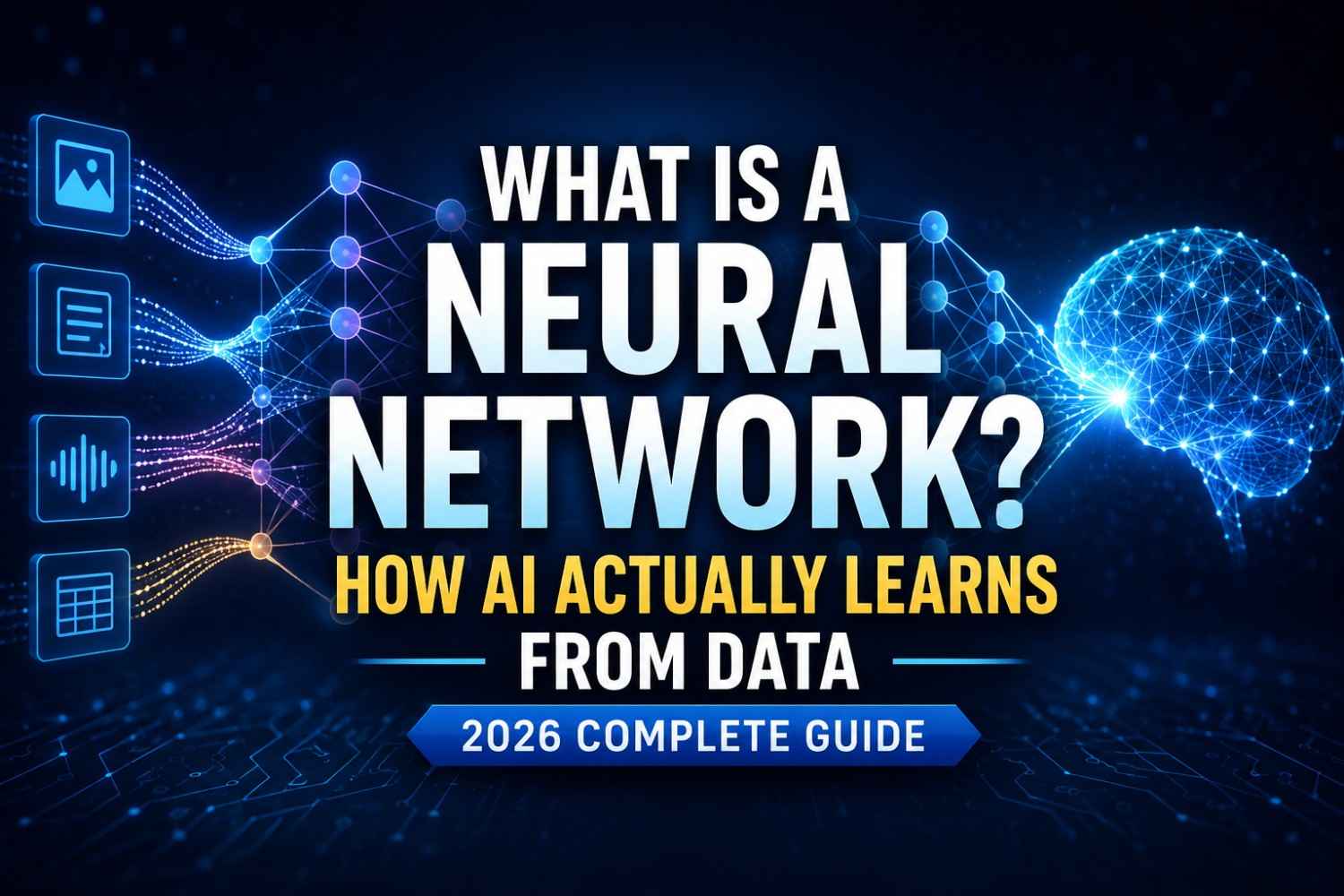
Neural Networks: AI’s Brain-Inspired Architecture
Neural networks are the technology that powers most modern AI breakthroughs and help explain how does AI work.
Biological Inspiration:
Neural networks loosely mimic the human brain:
- Neurons: Process information
- Connections: Transmit signals
- Learning: Strengthening important connections
Artificial Neural Networks:
Structure:
- Input Layer: Receives data (pixels, text, numbers)
- Hidden Layers: Process information through multiple stages
- Output Layer: Produces results (classification, prediction)
Simple Example:
Recognizing handwritten digits:
Input Layer: 784 pixels (28×28 image)
    ↓
Hidden Layer 1: 128 neurons (detect edges, curves)
    ↓
Hidden Layer 2: 64 neurons (detect number shapes)
    ↓
Output Layer: 10 neurons (digits 0-9)
How Neurons Work:
Each neuron:
- Receives inputs from previous layer
- Multiplies each input by a weight (importance)
- Adds all weighted inputs together
- Applies activation function (decides if neuron “fires”)
- Passes result to next layer
Learning Process:
Training adjusts weights:
- Initially: Random weights produce random outputs
- For each training example: Compare output to correct answer
- Calculate error (how wrong was it?)
- Adjust weights to reduce error
- Repeat millions of times
This process is called backpropagation—the network learns which connections matter most.
Deep Learning: Why Modern AI Is So Powerful
Deep learning is a subset of machine learning using neural networks with many layers (hence “deep”).
What Makes It “Deep”?
Traditional neural networks: 1-3 hidden layers Deep neural networks: 10-1000+ hidden layers
Why Depth Matters:
Each layer learns increasingly abstract features:
Image Recognition Example:
- Layer 1: Detects edges and lines
- Layer 2: Combines edges into shapes
- Layer 3: Recognizes textures
- Layer 4: Identifies object parts (ears, wheels)
- Layer 5: Recognizes complete objects (cats, cars)
Breakthrough Applications in 2025:
Computer Vision:
- Facial recognition
- Medical image analysis
- Autonomous vehicles
- Quality control in manufacturing
Natural Language Processing:
- ChatGPT and language models
- Translation services
- Sentiment analysis
- Content generation
Speech Recognition:
- Voice assistants
- Transcription services
- Voice-controlled devices
Generative AI:
- AI art (DALL-E, Midjourney)
- Music composition
- Video synthesis
- Code generation
Key Innovation:
Deep learning excels at handling unstructured data (images, text, audio) that stumped earlier AI approaches.
Training AI: The Step-by-Step Process
Understanding how does AI work requires knowing how systems actually learn.
Step 1: Collect Training Data
Requirements:
- Large volume (thousands to billions of examples)
- High quality (accurate, representative)
- Properly labeled (for supervised learning)
- Diverse (covers all scenarios)
Example: Building a spam filter requires millions of emails labeled as spam or legitimate.
Data Sources:
- Publicly available datasets (ImageNet, Common Crawl)
- Company proprietary data (customer interactions)
- Synthetic data (computer-generated)
- Crowdsourced labeling (human annotators)
Step 2: Prepare and Clean Data
Data Preprocessing:
- Remove duplicates and errors
- Handle missing values
- Normalize scales (0-1 range)
- Convert formats (text to numbers)
- Split into training/validation/test sets
Example Preparation: Images: Resize to consistent dimensions, adjust brightness, augment with rotations
Step 3: Choose Model Architecture
Decisions:
- Neural network type (CNN, RNN, Transformer)
- Number of layers
- Neurons per layer
- Activation functions
- Optimization algorithms
Common Architectures in 2025:
CNNs (Convolutional Neural Networks): Image and video processing RNNs/LSTMs: Sequential data, time series Transformers: Language models (GPT, BERT) GANs (Generative Adversarial Networks): Creating new content
Step 4: Train the Model
Process:
- Initialize: Random starting weights
- Forward Pass: Input data flows through network
- Calculate Loss: Measure prediction error
- Backward Pass: Compute weight adjustments
- Update Weights: Optimize to reduce error
- Repeat: Process entire dataset many times (epochs)
Training Duration:
- Simple models: Minutes to hours
- Large language models: Weeks to months on specialized hardware
- GPT-4 training: Estimated millions of dollars in compute
Hardware:
- GPUs (Graphics Processing Units): Parallel processing power
- TPUs (Tensor Processing Units): Google’s AI-specific chips
- Supercomputers: For largest models
Step 5: Validate and Test
Validation Set: Data the model hasn’t seen during training—checks for overfitting.
Test Set: Final evaluation of real-world performance.
Key Metrics:
- Accuracy: Percentage correct
- Precision: True positives / predicted positives
- Recall: True positives / actual positives
- F1 Score: Balance of precision and recall
Step 6: Deploy and Monitor
Deployment:
- Integrate into applications
- Optimize for speed (inference time)
- Set up monitoring systems
- Plan for updates
Continuous Learning: Many systems continue learning from new data in production, constantly improving.
How AI Makes Decisions: A Practical Example
Let’s see how does AI work in a real scenario: email spam detection.
Traditional Approach (Pre-AI):
IF email contains "viagra" THEN spam
IF email contains "$$$" THEN spam
IF sender unknown THEN maybe spam
Spammers easily bypass these rules.
AI Approach:
Step 1: Training Data
- 1 million emails labeled spam/legitimate
- Features extracted: sender, subject, body text, links, images
Step 2: Feature Engineering AI learns which features matter:
- Certain word combinations
- Sender reputation patterns
- Email structure anomalies
- Link destinations
- Image-to-text ratios
Step 3: Pattern Recognition Neural network discovers:
- Legitimate emails have consistent sender patterns
- Spam often has excessive capitalization
- Certain phrase combinations indicate phishing
- Timing patterns differ between types
Step 4: Prediction New email arrives:
Input Features → Neural Network → Probability Score

Email: "CLICK HERE TO CLAIM $1000000"
↓
Network processes features
↓
Output: 98% probability of spam
↓
Action: Move to spam folder
Continuous Learning:
- User marks spam incorrectly filtered → system learns
- New spam patterns emerge → retraining adapts
- Accuracy improves over time
Real-World AI Applications in 2025
Understanding how does AI work becomes clearer through current applications.
Healthcare AI
Medical Imaging:
- Detects cancer in X-rays/MRIs often before radiologists
- Analyzes retinal images for diabetes complications
- Predicts heart disease from ECG patterns
Drug Discovery:
- Simulates molecular interactions
- Predicts drug efficacy
- Reduces development time from years to months
Personalized Treatment:
- Analyzes genetic data for optimal medications
- Predicts patient outcomes
- Assists diagnosis with symptom analysis
Transportation
Self-Driving Vehicles:
- Computer vision identifies pedestrians, vehicles, signs
- Reinforcement learning optimizes navigation
- Sensor fusion combines camera, radar, lidar data
Traffic Optimization:
- Predicts congestion patterns
- Adjusts signal timing dynamically
- Routes vehicles efficiently
Finance
Fraud Detection:
- Identifies unusual transaction patterns in real-time
- Learns from new fraud techniques
- Reduces false positives
Algorithmic Trading:
- Analyzes market patterns
- Executes trades in milliseconds
- Manages risk automatically
Credit Scoring:
- Evaluates creditworthiness from diverse data
- Predicts default probability
- Provides instant loan decisions
Customer Service
Chatbots:
- Understand natural language questions
- Provide 24/7 support
- Escalate complex issues to humans
- Learn from interactions
Personalization:
- Recommends products based on behavior
- Customizes content for users
- Predicts customer needs
- Optimizes pricing dynamically
Content Creation
Text Generation:
- Writes articles, emails, code
- Summarizes long documents
- Translates languages
- Creates marketing copy
Image/Video Synthesis:
- Generates artwork from text descriptions
- Creates realistic faces
- Edits photos intelligently
- Produces video content
The Limitations: What AI Can’t Do
Current Constraints in 2025:
Lacks True Understanding: AI recognizes patterns but doesn’t genuinely comprehend meaning. It processes correlations without causal reasoning.
Data Dependent: AI only knows what’s in training data. Novel situations outside training distribution confuse systems.
Bias Amplification: AI inherits biases from training data. Historical inequities get encoded and amplified.
No Common Sense: AI lacks human intuition about how the world works. Simple reasoning that’s obvious to humans can stump AI.
Explanation Difficulty: “Black box” problem—AI decisions are often not interpretable. Hard to explain why specific prediction was made.
Energy Intensive: Training large models consumes massive electricity. GPT-3 training: ~1,300 MWh (equivalent to 130 homes for a year).
Adversarial Vulnerability: Small, carefully crafted inputs can fool AI systems. Slight image modifications cause misclassification.
No Creativity: AI remixes and recombines training data but doesn’t have original creative insight in the human sense.
The Ethics and Future of AI
Key Ethical Concerns:
Privacy: AI systems require massive personal data, raising surveillance and consent issues.
Bias and Fairness: Facial recognition works better on some demographics. Hiring AI may discriminate based on historical patterns.
Job Displacement: Automation threatens certain jobs while creating new roles requiring different skills.
Accountability: Who’s responsible when AI makes harmful decisions? The developer? User? The AI itself?
Misinformation: Deepfakes and AI-generated content make truth increasingly hard to verify.
AI Safety: Ensuring powerful AI systems remain aligned with human values and intentions.
The Path Forward:
Regulation: Governments worldwide developing AI oversight frameworks balancing innovation with protection.
Transparency: Movement toward explainable AI that can justify decisions.
Inclusive Development: Diverse teams building AI to reduce bias and ensure broad benefit.
Education: Teaching AI literacy so everyone understands capabilities and limitations.
Expert Tips for Understanding AI Better
For Curious Learners:
- Experiment with AI tools: ChatGPT, DALL-E, Google Lens—hands-on experience builds intuition
- Take online courses: Coursera, edX offer beginner-friendly AI introductions
- Watch visualizations: 3Blue1Brown’s neural network videos are excellent
- Read accessible books: “Life 3.0” by Max Tegmark, “Prediction Machines” by Ajay Agrawal
For Critical Consumers:
- Question AI outputs: Remember AI makes mistakes and has biases
- Check sources: Verify AI-generated information independently
- Understand limitations: Don’t trust AI beyond its capabilities
- Protect privacy: Be mindful what data you share with AI systems
For Aspiring Developers:
- Learn Python: The dominant AI programming language
- Master libraries: TensorFlow, PyTorch for deep learning
- Work with datasets: Kaggle provides free datasets and competitions
- Start small: Simple projects first, gradually increase complexity
- Join communities: AI subreddits, Discord servers, GitHub discussions
Visual Content Suggestions
Image 1: Neural Network Architecture Diagram
Description: Simplified visual showing input layer, hidden layers, and output layer with connections illustrating how data flows through.
AI Image Prompt: “Create educational diagram of neural network architecture. Show three layers: input layer (9 nodes receiving image data), two hidden layers (6 nodes each) with connecting lines between nodes, output layer (3 nodes showing classifications). Use blue nodes, green connections, arrows showing data flow direction. Style: clean, educational infographic, modern color scheme.”
ALT Text: “Neural network diagram showing how does AI work through connected layers processing data”
Image 2: Machine Learning Types Comparison
Description: Three-panel illustration comparing supervised, unsupervised, and reinforcement learning with simple examples.
AI Image Prompt: “Create three-panel infographic comparing machine learning types. Panel 1: Supervised learning showing labeled cat/dog images with arrows. Panel 2: Unsupervised learning showing clustering of unlabeled data points. Panel 3: Reinforcement learning showing agent receiving rewards/penalties. Use icons, simple illustrations, consistent color coding. Style: modern flat design, educational, clear visual distinctions.”
ALT Text: “Comparison of supervised, unsupervised, and reinforcement learning types in AI”
Image 3: AI Training Process Flowchart
Description: Step-by-step flowchart from data collection through deployment showing the complete AI development lifecycle.
AI Image Prompt: “Create flowchart showing AI training process: 1) Collect data icon, 2) Clean/prepare data, 3) Choose model architecture, 4) Train with arrows cycling, 5) Validate/test with checkmark, 6) Deploy to production. Use icons for each step, arrows connecting flow, circular arrow showing iteration. Style: professional diagram, blue/green color scheme, clear progression.”
ALT Text: “Flowchart showing step-by-step process of how AI systems are trained and deployed”
Frequently Asked Questions
Q1: Can AI think like humans?
No. AI recognizes patterns and makes predictions based on training data, but it doesn’t have consciousness, understanding, or genuine reasoning. Current AI (narrow AI) excels at specific tasks but lacks general intelligence, common sense, and true comprehension. It processes correlations without understanding causation or context the way humans do.
Q2: How much data does AI need to learn?
It varies widely. Simple tasks might need thousands of examples, while complex tasks like language understanding require billions. Generally, more data improves performance, but quality matters more than quantity. Well-curated, diverse, representative data produces better results than massive amounts of low-quality data. Modern techniques like transfer learning reduce data requirements.
Q3: Is AI actually intelligent or just advanced pattern matching?
Current AI is sophisticated pattern matching rather than true intelligence. It finds statistical correlations in training data without genuine understanding. However, the patterns it detects are incredibly complex and useful. Whether this constitutes “intelligence” depends on how you define the term—philosophically debatable, but practically, AI accomplishes tasks that previously required human intelligence.
Q4: Can AI learn on its own without human input?
AI requires significant human involvement: humans collect/label training data, design architectures, choose algorithms, and evaluate performance. Some systems use unsupervised or reinforcement learning to discover patterns independently, but humans still define the learning framework, goals, and constraints. Fully autonomous AI that learns without any human guidance doesn’t exist in 2025.
Q5: Will AI take my job?
AI will transform many jobs rather than eliminate them entirely. Routine, repetitive tasks are most vulnerable to automation. However, AI also creates new roles and augments human capabilities. Jobs requiring creativity, emotional intelligence, complex problem-solving, and human interaction are less threatened. Focus on developing skills that complement rather than compete with AI—critical thinking, creativity, interpersonal communication, and adaptability.
Conclusion
Understanding how does AI work reveals it’s not magic—it’s mathematics, statistics, and pattern recognition at massive scale. AI learns from examples, identifies relationships in data, and makes predictions using neural networks inspired by the human brain.
Key Takeaways:
- AI learns from data rather than following programmed rules
- Neural networks process information through layers, learning increasingly abstract patterns
- Machine learning comes in three types: supervised, unsupervised, and reinforcement
- Deep learning’s many-layered networks power modern AI breakthroughs
- AI excels at specific tasks but lacks general human-level intelligence
- Training requires massive data, computing power, and human expertise
- AI has limitations: bias, lack of understanding, and vulnerability to novel situations
AI in 2025 is powerful but narrow. It assists humans rather than replaces human judgment. The technology will continue evolving, making AI literacy increasingly important for everyone.
Take Action: Experience AI firsthand. Try ChatGPT for questions, use Google Lens for image recognition, or explore AI art generators. Hands-on interaction builds intuition better than any explanation. Understanding AI empowers you to use it effectively while recognizing its limitations.